
• There has been a recent cluster of spammers accessing BARFer accounts and posting spam. To safeguard your account, please consider changing your password. It would be even better to take the additional step of enabling 2 Factor Authentication (2FA) on your BARF account. Read more here.

Strange design feature on Akrapovic Evolution exhaust systems

Feanor

Unmasked
Joined
Aug 20, 2004
Location
Dublin
Moto(s)
2008 ZX-10R, 2004 KDX-220R
Name
David
I have an Akrapovic Evo system on my bike, and I've always been curious about a certain design feature of the header pipe.

If you look at the image below, right where the header pipes make their bend out of the engine, the radius has an odd flat indentation which chokes down the diameter of the tube by a significant amount.

At first glance it looks very much like it's nothing but a restriction to maximum exhaust gas flow, but I think everyone knows that Akra has a pretty good idea of what they're doing so I assume only that it's some research design element that increases performance in SOME way, as it would be far simpler to make the bend a normal radius throughout.

Does anyone have an idea what the physics and theory is behind this choking down of the pipes the way they are? In my experience, Akrapovic is the only exhaust system manufacturer that does this.

Hopefully you can see it clearly in the image
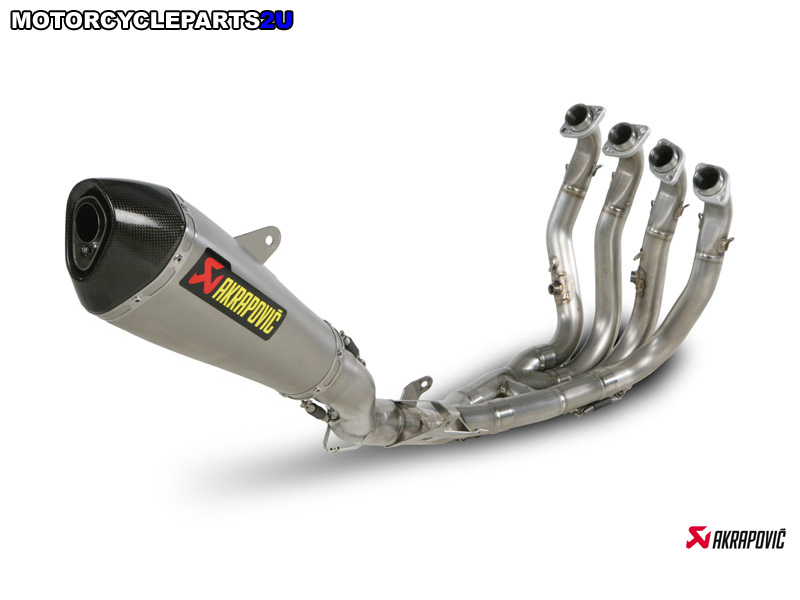
1810-1831-akrapovic-evolution-full-exhaust-with-hexagonal-muffler.jpg
 
Google "Venturi effect"- and you will have you're answer...
 
Indeed, it's a Venturi to assist with exhaust scavenging and movement of air from the cylinders.
 
Thanks!

I was thinking along those lines, but I've always associated venturi effect with sucking in, not blowing out... Ok that sounded lewd :laughing
 
Have you tried asking Akrapovic (and don't use terms like choking down, or weird, or sucking or blowing) You are interested in air flow, and that air flowing while turning a corner, and complications with "reverse flow".

Ask the question like your talking to professionals in the business...and You regard them as such...and you want to gain a greater appreciation of their product.

They still might not answer the question...because they don't know the "who" of who is asking, and how that information might be used....but...They might tell you exactly what is going on there.

If they don't...just be happy with Venturi = low pressure, at a place where a reduced pressure is a good thing.
 
Akra is one of the only companies that makes a system that has features like that available to the general public. If you have ever dealt with people that make the exhausts for the top racers(hint hint : it's not the company that is stamped on them 90% of the time) There are all kinds of different techniques that are used. Most can't be seen from outside the pipe. It's not all about flow. Heat is a huge consideration as well. Heat makes power. ;)
 
Less venturi and more about fluid flow around a radius. I believe Micron was the first to market the concept in a commercial product.
 
Whatever it is you can bet it's a lot of educated trial and error and they might not even know completely. I doubt exhaust flow is something you can properly model on the kind of budget that sells motorcycle parts.
 
Less venturi and more about fluid flow around a radius. I believe Micron was the first to market the concept in a commercial product.

+1
Exhaust gases get pushed to the outside bend of the pipe, making a vortex of gases on the inside bend creating a negative flow. By flattening out the inside they get rid of the area where that negative flow would get created.

Whatever it is you can bet it's a lot of educated trial and error and they might not even know completely. I doubt exhaust flow is something you can properly model on the kind of budget that sells motorcycle parts.

I disagree. As mentioned above, Micron for example, used fluid flow to model how gases would behave. They also used water pressure to bend their pipes into shape.
 
Last edited:
Back
Top