• There has been a recent cluster of spammers accessing BARFer accounts and posting spam. To safeguard your account, please consider changing your password. It would be even better to take the additional step of enabling 2 Factor Authentication (2FA) on your BARF account. Read more here.

Amsoil Oil & Filters?

Jmaster

New member
Joined
Oct 13, 2015
Location
NorCal
Moto(s)
2009 Honda CBR600RR AFM#609
I recently got a preferred account with Amsoil for free as an AMF racer and was looking at using their 10W40 Synthetic Metric Motorcycle Motor Oil for racing. Does anyone have any experience running it or any Amsoil filters or other products in their race motorcycle?

THill This Saturday!!

Justin
 
I've used and sold Amsoil at the dealership I worked at for several years .
There are no "bad" oils these days.
As long as the oil meets the specs for your bike, you are good to go.
Just moniter the oil level since the oil is new to you. It may pass a little more than your current brand.
I'm sure the filters are fine too but several tracks have banned aftermarket spin on filters and require factory OEM only.
Of your filter is a canister type, you should be good.
 
Last edited:
Generally speaking, Amsoil lubricants are the best money can buy. I use their cleanable air filter in my high performance Mini. It is not an oiled type and seems to be of very high quality, though I'm sure someone makes it for them. I think.

Their oil, at any rate, is the real deal. Some oils come close but rarely equal Amsoil.

For oil filters I always use OEM.
 
I don't think it matters what high quality synthetic oil you run, if I'm spending 15 bucks a quart I'd support red line oil as they are from benicia instead of a Wisconsin cheese head. If you listen to amsoil message it seems cultish. I'd run the oil and see how it holds up but I run 1500 mile changes on delo diesel, have at it.
 
I agree that Amsoil seems cultish and their marketing schemes seem weird but their lubes really are top notch and arguably the best.

If you don't want to run Amsoil, the other two that are tops in my book are Redline and Mobil 1. And Redline is local to the Bay Area.
 
I've had great experiences with redline products
 
Sounds like Amsoil is the real stuff. I do agree, I like supporting local brands as much as I can. Sometimes its just hard to pas off a good discount. The savings adds up and nothing for bikes is cheap.

Thanks for the info. Ride Safe.
 
I don't think it matters what high quality synthetic oil you run, if I'm spending 15 bucks a quart I'd support red line oil as they are from benicia instead of a Wisconsin cheese head. If you listen to amsoil message it seems cultish. I'd run the oil and see how it holds up but I run 1500 mile changes on delo diesel, have at it.

On my diesel, I run 1 year or 25,000 miles (never make that number) oil changes with Amsoil. Cheaper than Delo at that rate.

I put Amsoil in all my vehicles and generally run the drain interval they recommend for the oil I'm using. Put plainly, their stuff does the job they say it will.
 
The choice is yours, but choosing a 30w over a 40w is smarter because it will:

1)increase 2 to 3 HP at the rear wheel
2)quicken the throttle response coming out of the corners...
3)decrease over all operating temps...
4)increase the oil flow at the critical bearings...

Any one of 30w 100% synthetic motorcycle specific or car oils will meet
and exceed both your racing and mileage expectations...

Quote 540Rat
SECTION 2 – MOTOR OIL VISCOSITY SELECTION

THE BENEFITS OF USING THINNER OIL:

• Thinner oil flows quicker at cold start-up to begin lubricating
critical engine components much more quickly than thicker oil can.
Most engine wear takes place during cold start-up before oil flow can
reach all the components. So, quicker flowing thinner oil will help
reduce start-up engine wear, which is actually reducing wear overall.

• The more free flowing thinner oil at cold start-up, is also much
less likely to cause the oil filter bypass to open up, compared to
thicker oil. Of course if the bypass opened up, that would allow
unfiltered oil to be pumped through the engine. The colder the ambient
temperature, and the more rpm used when the engine is cold, the more
important this becomes.

• Thinner oil also flows more at normal operating temperatures. And
oil FLOW is lubrication, but oil pressure is NOT lubrication. Oil
pressure is only a measurement of resistance to flow. Running thicker
oil just to up the oil pressure is the wrong thing to do, because that
only reduces oil flow/lubrication. Oil pressure in and of itself, is
NOT what we are after.

• The more free flowing thinner oil will also drain back to the oil
pan quicker than thicker oil. So, thinner oil can help maintain a
higher oil level in the oil pan during operation, which keeps the oil
pump pickup from possibly sucking air during braking and cornering.

• The old rule of thumb that we should have at least 10 psi for every
1,000 rpm is perfectly fine. Running thicker oil to achieve more
pressure than that, will simply reduce oil flow for no good reason. It
is best to run the thinnest oil we can, that will still maintain at
least the rule of thumb oil pressure. And one of the benefits of
running a high volume oil pump, is that it will allow us to enjoy all
the benefits of running thinner oil, while still maintaining
sufficient oil pressure. A high volume oil pump/thinner oil combo is
preferred over running a standard volume oil pump/thicker oil combo.
Because oil “flow” is our goal for ideal oiling, NOT simply high oil
pressure.

• Oil flow is what carries heat away from internal engine components.
Those engine components are DIRECTLY oil cooled, but only INdirectly
water cooled. And better flowing thinner oil will keep critical engine
components cooler because it carries heat away faster. If you run
thicker oil than needed, you will drive up engine component temps. For
example: Plain bearings, such as rod and main bearings are lubricated
by oil flow, not by oil pressure. Oil pressure is NOT what keeps these
parts separated. Oil pressure serves only to supply the oil to this
interface. The parts are kept apart by the incompressible hydrodynamic
liquid oil wedge that is formed as the liquid oil is pulled in between
the spinning parts. As long as sufficient oil is supplied, no wear can
occur. In addition to this, the flow of oil through the bearings is
what cools them.

Quote Gmtech94

When I raced we were sponsored by an oil company and helped with the
research of their product .The thought at the time was to run 20w50
race oil to provide for the best lubrication under racing conditions
hence no oil related failures . After many races and a lot of real
data research the conclusion was in this case to run a 10w30 oil as it
provided better lubrication and less engine wear over a long period of
time ,remember endurance racing in 24 and 30 hour races . Although we
never had an engine failure due to oil properties we did have a lot of
feedback on engine wear as well as transmission and clutch wear . I
have to say we did abuse these bikes on occasion with spinning the
back wheel to turn the bike as well as the occasional fall .The
ignition was a weak link but I could change out the pulsers in about
17 seconds once the bike was in the pits . In conclusion 10w30 ran
cooler and did not break down as much as the thicker oils did.

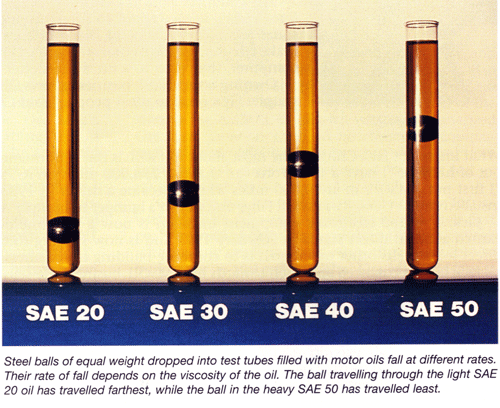
Oil drag in a tube comparison

viscosity_test.gif
 
Mobil 1 versus Amsoil

Its up to you whether you want to spend $64.75 @ $12.95 qt for Amsoil 10w30
or $27 @ $5.40 qt Mobil 1 5w30 because Amsoil base stock is really 30w Mobil 1...

You Tube Video where Amsoil rep names Mobil 1 premium PAO as
the base stock for their oils...

[youtube]E_iN_IJpSIU[/youtube]
 
Mobil 1 versus Amsoil

Its up to you whether you want to spend $64.75 @ $12.95 qt for Amsoil 10w30
or $27 @ $5.40 qt Mobil 1 5w30 because Amsoil base stock is really 30w Mobil 1...

You Tube Video where Amsoil rep names Mobil 1 premium PAO as
the base stock for their oils...

[youtube]E_iN_IJpSIU[/youtube]

Sure. i guess.

Who does the additives package belong to?
 
Don't think there's many oils that will hold their viscosity as long as Amsoil does, and honestly, the price isn't that bad. I know the motuls and other fancy oils are many times more expensive. I run it in my ford ranger (it burns a lot of oil, the amsoil lasts longest before it starts to disappear) and my bikes. I first started using it about 9 years ago when I had oil pressure solenoid failure on my Acura Integra GSR with off the shelf oils and researched oils with a more consistent viscosity.
 
I recently got a preferred account with Amsoil for free as an AMF racer and was looking at using their 10W40 Synthetic Metric Motorcycle Motor Oil for racing. Does anyone have any experience running it or any Amsoil filters or other products in their race motorcycle?

THill This Saturday!!

Justin

dont use alsmoil filters stay away. but oil is good !!!
 
been using amsoil on my superhawk.

125k miles on the bottom end with no probs.
 
Back
Top