• There has been a recent cluster of spammers accessing BARFer accounts and posting spam. To safeguard your account, please consider changing your password. It would be even better to take the additional step of enabling 2 Factor Authentication (2FA) on your BARF account. Read more here.

Chain oilers

This would be on my NC700X, which will never see the track.

The amount of oil that comes off the chain is negligible vs how much many vehicles leak.
 
It seems to me that some people interpret "o- and x-ring chain links are greased and sealed" equates to "ya don't need to oil the chain". Weird.

For o/x-ring chains with the beneficial grease/lube sealed inside the rings...

My take is that periodic chain lube/wipe treatments helps keep the external parts of the o/x-rings clean of grit and the seals supple, extending service life until the chain itself eventually succumbs to normal wear and tear.

Added bonus being a visually nice non-rusty looking chain.
 
Last edited:
For o/x-ring chains with the beneficial grease/lube sealed inside the rings...

My take is that periodic chain lube/wipe treatments helps keep the external parts of the o/x-rings clean of grit and the seals supple, extending service life until the chain itself eventually succumbs to normal wear and tear.

Added bonus being a visually nice non-rusty looking chain.

Inside the rings is not the only place a chain drive system wears. The outside of the rollers and the sprocket teeth also wear. A good lubricating paste is a good idea as mentioned earlier. And if that paste has a high moly or tungsten disulfide content, that's even better. Both of those materials are dry lubricants that work their way into the micro pores and irregularities in the metal surfaces and they stay there after the carrier (the paste itself) is long gone. These two dry lubricants can take extremely high pressure and extremely high temps and that's why they're perfect for chains and sprockets.
 
In theory, a chain oiler should extend the life of the chain (outside the sealed areas) and of the sprockets. By how much is debatable.

I have had a Scottoiler on my RVF400 for over 1.5 years and in that time I've only had to adjust my chain 1x (due to my oiler running out of oil). I commuted on that bike on average 3.5x/week and put on 10K miles. From my perspective, they absolutely increase the lifespan of your chain. There is one caveat though - no matter how low I turn down my oiler I still end up with it making a mess. On my Tuono V4 I opted to attempt to be better about lubing my chain as I just don't' want to deal with the mess.
 
My take is that periodic chain lube/wipe treatments helps keep the external parts of the o/x-rings clean of grit and the seals supple, extending service life until the chain itself eventually succumbs to normal wear and tear.
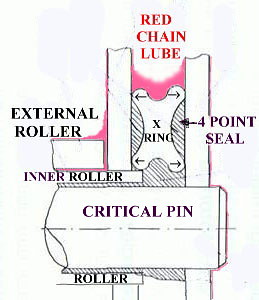
Technically speaking the old rubber O rings are no longer employed by
chain manufactures and the reasons are:

1)Poor Resistance to Drying Out (as you pointed out)
2)High Drag
3)Sealed at only 2 points
4)No Reservoirs of Lube

Currently we have the X rings designed out of the new fluoroelastomer
product known commercially as Viton or Kalrez and reasons are:

1)Excellent Resistance to Drying Out
2)Low Drag
3)Seals at 4 points
4)Grooved Reservoirs of Lube

What that means for us is the fact Viton or Kalrez X rings will be
100% serviceable far beyond a chain's first adjustment mileage point
where metal to metal wear begins to happen at the critical pin and
roller junction...

14746956046_fb75bdf189.jpg
 
I have had a Scottoiler on my RVF400 for over 1.5 years and in that time I've only had to adjust my chain 1x (due to my oiler running out of oil). I commuted on that bike on average 3.5x/week and put on 10K miles. From my perspective, they absolutely increase the lifespan of your chain.
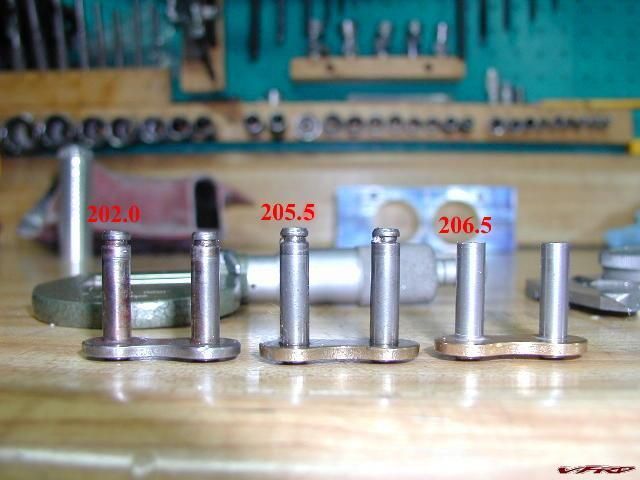
I love the mini RC45 but every time you adjust the chain its because of wear
and it will take more of your engines HP to spin the rear wheel... you can track
the drop of HP on the dyno...

This is what you don't see behind the X rings... metal to metal wear
every time you adjust the chain that eats into your engine's available
HP... 206.5 is new 205.5 is at the 8K mile mark... looks good but
multiply 1 thousand of an inch times 108 links and you have 108
thousands of an inch wear or about the range of the green marks
provided by Honda's wear gauge... 202.8 show the very visible wear at
the 12K mile mark... your chain is all pretty on the out side but all rotten
on the inside...

206.5 is new link
205.5 is 8K mile mark (chain worn out)
202.8 is at 12K mile mark (chain abuse... evidence red oxides of harden metal wear)

gallery_3131_51_50064.jpg
 
I bought my Sprint ST with 37000 miles, and a Scottoiler. No idea if the chain had been replaced since new. After using the container of Scottoil that came with the bike, I continued refill the oiler with motor oil. I finally replaced the chain and sprockets just prior to selling the bike with 65000 miles.
 
The outside of the rollers and the sprocket teeth also wear.

I agree... but the first sign of wear is always hidden behind the X ring at the
critical pin and roller junction... keep riding far enough to wear out the teeth and
you'll see the red oxides of harden metal exploded pass the X ring... now you're
guilty of chain abuse...

attachment.php
 
The amount of oil that comes off the chain is negligible vs how much many vehicles leak.
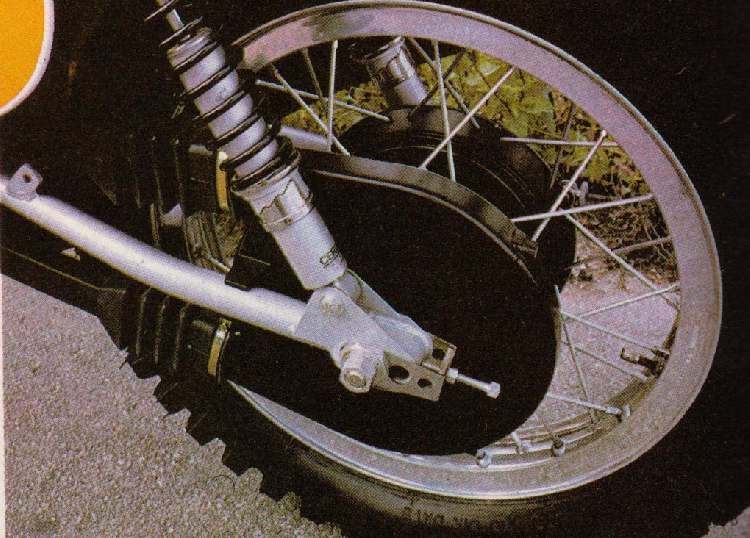
For an Auto Oiler to be cost effective first remove the X rings so the
oil has a chance to reach the critical pin and roller junction... next
enclose the drive train to isolate the oil fling from coating your prize in oil...

enclosedchain.jpg
 
if I could easily convert the NC to belt drive I would. I imagine it took you a fair amount of work to do it on your Interceptor.
 
if I could easily convert the NC to belt drive I would. I imagine it took you a fair amount of work to do it on your Interceptor.

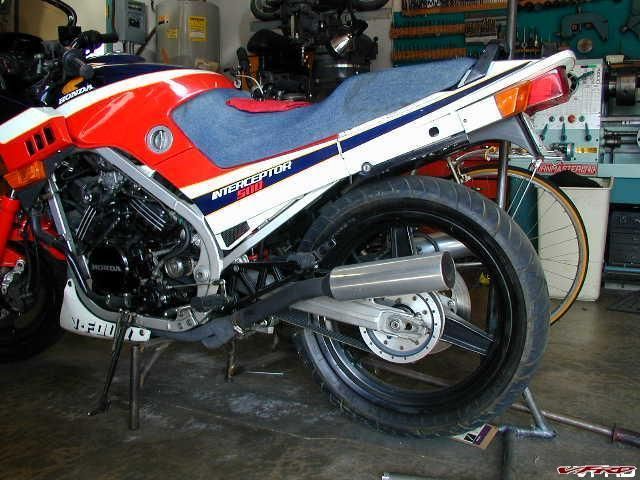
Amen... Chains are a pain... Belts spell relief...

When I quizzed Honda's engineers at Daytona about a belt drive
conversion they said "Larry its impossible to belt drive their bike,
you'd have to start with the belt and engineer the whole bike around
it"... really??? well 8 months of engineering and machining parts my
86 VF500F Interceptor became the famous 500 Belt-0-Ceptor and I racked
up 98,000 trouble free miles... you should have seen the look on those
engineer's face when they inspected THEIR bike... they asked "what's
next?" build my own frame I shot back... "OK" they said "you probably
could do that".

ce5BVi3.jpg


gallery_3131_51_14630.jpg


Riding the littlest bike among bigger "Motors of Death" can be a recipe for bruised egos...
qBUdODI.jpg
 
For an Auto Oiler to be cost effective first remove the X rings so the
oil has a chance to reach the critical pin and roller junction... next
enclose the drive train to isolate the oil fling from coating your prize in oil...

enclosedchain.jpg


Alright already. We get it. You don't see the point in oiling a chain :deadhorse
 
Back
Top