• There has been a recent cluster of spammers accessing BARFer accounts and posting spam. To safeguard your account, please consider changing your password. It would be even better to take the additional step of enabling 2 Factor Authentication (2FA) on your BARF account. Read more here.

Change your brake fluid!

RBF600 is only DOT4, as an example, even though it's rated at 600F

On the label RBF600 is rated "typically at 594ºF" which means generally speaking
but in order to meet a Government DOT standard every time they are tested
they cautiously claim absolutely their fluid meets DOT4 rating of 446ºF...

rbf600_usa.jpg
 
Last edited:
I trust Motul's quality control to be such that something with a typical dry boiling point of 594 to always boil above 518. That would take spectacularly bad control to fail.
 
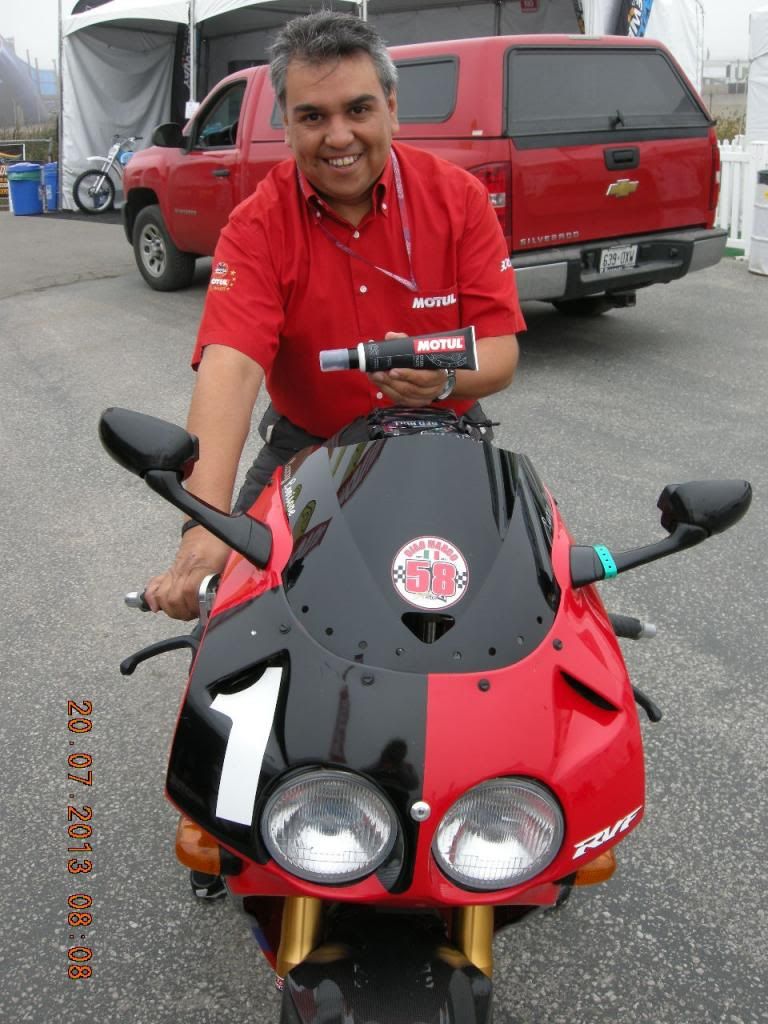
I also trust Motul because I know the factory reps on a personal level and in our
conversations I've learned go by the DOT standard more than the bold 600 labeling...

MrRC45Joey1_zps57c06579.jpg
 
Over the years I have worked on a few old motorcycles (not that old, but 15-35 years range), and there is one common issue I see with every single brake system. The brake fluid is old, crusty, gelatinous, brown-ish, black-ish crap. Then, the seals get distorted, the pistons corrode, and the internals corrode.

I have met people who didn't know you even had to change your brake fluid!

You should change your brake fluid completely every 2-3 years at a minimum.
chart2.jpg


Here's my latest project and what I'm dealing with. This caliper had to be completely replaced.
XXPKM2u.jpg


It only takes 30 minutes to get some new fluid in there. A complete rebuild and flush takes more work but is probably worth it every 8-10 years to remove built up crud.

Bought a new to me dirt bike a couple of months ago. About an hour into the first real ride at Hollister I step on the rear brake going downhill into an off camber single track turn and the rear brake is not there. Pedal goes all the way down and so do I :rofl Luckily I was not on a cliff and I bounced down the hill unhurt. The rear brake would come and go the rest of the ride. I bring the bike home and bleed the brake. The fluid is so old and dark. I've never seen worse. The bike was older but only had 82 hours on it The fluid looked like it had never been changed. The moral of the story is change your brake fluid every couple of years at least.
 
I'm so lazy to change brake fluid it's so easy on a motorcycle also. =P One day I will have a brake bleeding/change party so I can get the most out of that sealed brake fluid bottle.
 
In the old days, was pretty easy to refresh the brake fluid ... and still people didn't do it. :)

Now with ABS, it is more complicated. Any tips for changing it (on common type bikes)?

Since the brake lines go into an ABS unit and then to the brake calipers, most service manuals talk about the proper way to activate the ABS when bleeding. Some have special tools (like computer hooked up to bike, procedure to go thru to get the ABS unit to activate so you are pumping out all that fluid).

If you use an old school approach on a modern ABS bike, is that good enough? So you use a Mity Vac, pulling fluid out at the caliper, adding fresh fluid at the reservoir, pumping up brake levers, etc. And do not do the "proper" ABS activation process ... that work??
 
What I want to know is what idiot(s) decided to label the next level of glycol based fluids 5.1 instead of 6.

Me too. It could have been so organized, so sensible--a smooth save after fucking it all up by using "5" in the first place. Next lifetime, maybe.
 
I also trust Motul because I know the factory reps on a personal level and in our
conversations I've learned go by the DOT standard more than the bold 600 labeling...

I bought and used that chain paste on the recommendation of someone here. It really works well. Almost no fling.

Changing out brake fluid every year or two depending on climate is a no brainer. Getting a power bleeder if you own multiple vehicles is a dream. So fast.
 
On the label RBF600 is rated "typically at 594ºF" which means generally speaking
but in order to meet a Government DOT standard every time they are tested
they cautiously claim absolutely their fluid meets DOT4 rating of 446ºF...

rbf600_usa.jpg

that's what I use.
bleeding the brakes before each weekend at the track is also a must
 
I recommend comparing the WET boiling point of brake fluids, as this is most likely what you'll be riding around with for the majority of time between changes.

I ran many types of DOT4 brake fluid and boiled all of them besides ATE super blue racing brake fluid and whatever their current equivilent is. I change my brake fluid annually, which is better than average but still allows ample time for moisture accumulation. I'm sure there are other brands that work well, but I boiled several expensive brands before finding one that I could leave in the car for 6 months and still not have issues with brake fade. The high end race stuff is only great when dry, check the labels. For what it's worth, I have not tried the castrol SRF or using motul after a thorough flush, that was an early experiment. I've been too slow for the past 6 years to really NEED high end brake fluid, so my experience is not with the cutting edge technology.

ATE: 388*F wet
MOTUL: 383*F wet
Castrol SRF: 518*F wet
castrol advanced performance : 329*F wet
Prestone: 311*F wet
 
Last edited:
Back
Top