• There has been a recent cluster of spammers accessing BARFer accounts and posting spam. To safeguard your account, please consider changing your password. It would be even better to take the additional step of enabling 2 Factor Authentication (2FA) on your BARF account. Read more here.

How can I mount front signal lights to my naked SV650s?

Awesome. Nice to see Aram is much more than just a funny avatar.

I surprised myself this morning when I realize I wasn't a kitten passed out. :laughing

Actually it was fun hooking up the lights and we came up with a fairly elegant solution and used factory connectors with everything soldered so it turned out pretty well. Too bad it rained halfway through and the working space in the garage wasn't ideal but it got done and hopefully the bike is a little safer now!

Funny thing is with all oe blinkers (incandescent) they blink double speed. I think the PO might have installed a different blinker relay thing maybe?
 
they blink double speed. I think the PO might have installed a different blinker relay thing maybe?

Yes, that's a key give-away. Download the manual, find the right relay (Kragens/Pep Boys, etc.) should carry it.
 
Funny thing is with all oe blinkers (incandescent) they blink double speed. I think the PO might have installed a different blinker relay thing maybe?

Good guess but doubtful.

The 2nd gen blinker relay is integrated into the fuse box.

Bulbs must have lower resistivity is all.

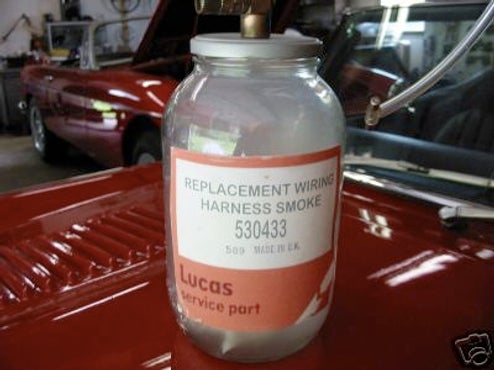
You topped off the blicker fluid, right?
 
Yes, that's a key give-away. Download the manual, find the right relay (Kragens/Pep Boys, etc.) should carry it.

I like the idea of a fast blinking turn signal: it helps draw attention to you.
 
Here's a picture!

IjOmS1q.jpg


What's blicker fluid?

I don't mind the fast blinking either. Has been working great! :ride
 
Last edited:
Blicker fluid (named after Hans Blicker, Lucas Electrics) is a low-capacitance volumetric response to the blinkers being used. The problem occurs when there are gaps in the insulation and the fluid seeps out.
 
Blicker fluid (named after Hans Blicker, Lucas Electrics) is a low-capacitance volumetric response to the blinkers being used. The problem occurs when there are gaps in the insulation and the fluid seeps out.

Hans also perfected the infamous Lucas 3-position 'D-F-O'* switch.

*(dim, flicker & off) :teeth
 
ConduitClampBolt_ZM.jpg


Used two of these conduit clamps for my GSXR when I had to do the brake and light test for registering the bike.
 
Bump

I'm encountering a similar issue.

To begin, my bike came to me with a semi-hack job from an S to N conversion with a front end swap. It worked so I didn't mess with it.

A couple years of regular use makes me want front turn signals now after lacking them for so long. I bought another full harness and headlight harness to figure out what stays and what goes.

I've begun on the headlight harness which will be significantly shortened closer to the day of execution. I have a question that I'm hoping somebody can answer since I have pretty much no experience with this stuff. I've been using the diagrams which are very straightforward but couldn't figure out the significance of a particular bit that I want to cut out and bypass if possible.

Said bit with the black cap:


Headlight Harness semi-thinned:


The little space I'm working with between the headlight and gauge cluster:


Is the piece I'm trying to remove some type of resistor? Is there a way to bypass it safely?
 
Can you get some better pictures of it? If it has a part number written on it, Google that number...

Do you have a wiring diagram?
 
Can you get some better pictures of it? If it has a part number written on it, Google that number...

Do you have a wiring diagram?

I've been using a wiring diagram found on the web.

Another source of feedback stated that the little connector with the black cap is a grounding node in which I should not remove it.

I couldn't find a part number but it's looking like its removal would mess with the grounding of the headlight and signals.
 
Close of pic of said node and connector to main harness:


Overall view of headlight harness before the wires are significantly shortened:


All that's left on the headlight harness are the headlight, turn signals, the ground node, and the connector to the main harness.
 
That sure looks like a jumper, so the factory could delete something not needed for the US market without making a special harness. I bet a multimeter would tell the tale of which wires to soldr together to enable deleting it

My guess is All Of Em.
 
That sure looks like a jumper, so the factory could delete something not needed for the US market without making a special harness. I bet a multimeter would tell the tale of which wires to soldr together to enable deleting it

My guess is All Of Em.

Thanks for the feedback.

I'm new to the world of the messing with electronics so I'm trying to take baby steps as not to fry the whole system and burn my bike down.

As it stands in its current state, there is no "ground node/jumper" thing installed on the bike. The previous owner cut the connector to the headlight harness and wired just the headlight. That means the black, green, and brown wires are tucked right next to where the connector should be.
 
It's just a jumper to interconnect all those grounds together

I see. So theoretically, could I bypass the jumper by feeding all the wires into a single connection with sautering?

Here's a pic with the tape unwrapped leading into the jumper:


The two b/w wires farthest to the left are the turn signal ground wires.

The top right b/w wire feeds to the headlight and the bottom right feeds to the connector to the full harness.

I envision combining the two turn signal grounds with the headlight ground then connecting it to the ground leading to the main harness.


Sorry if my questions sound basic and/or unintelligent. I'm super amateur at this.
 
Yes you can combine all of those. Figure out which one actually connects to a chassis ground, or makes the run back to the negative battery terminal and use that as your "connect to here" wire. It sounds like it's the one you're calling "bottom right" and should be one of if not the biggest diameter wire (which is sometimes different than the largest diameter insulation+wire )
 
Back
Top