
• There has been a recent cluster of spammers accessing BARFer accounts and posting spam. To safeguard your account, please consider changing your password. It would be even better to take the additional step of enabling 2 Factor Authentication (2FA) on your BARF account. Read more here.

Long stroke vs. short stroke

Clem Kevin

Nude With Boots
Joined
Nov 30, 2010
Location
Petrolia
Moto(s)
SV650, XR400
Name
Kevin
So, everyone is out buying the ktm/husqvarna 350 these days, and I'm just trying to keep up on my XR400 when I go riding with them. I finally took one of those 350s for a ride, and I gotta say it was an amazing machine, but I don't want one.

One thing that really set me off was the vibrations from the motor:

The owner and I were talking about it, and he said most modern dirt bikes are have a oversqure bore/stroke ratio and will have similar vibrations (more high frequency).

So I thought this might stir up an interesting discussion and I'm looking to see how people will answer these two questions:

Do you prefer a long or short bore/stroke ratio on a dirt bike?

Are there any modern dirt bikes (350 is 72x73) with a particularly long stroke like my XR (85x70)?

PS, I might have no idea what I'm talking about. I'm tired.
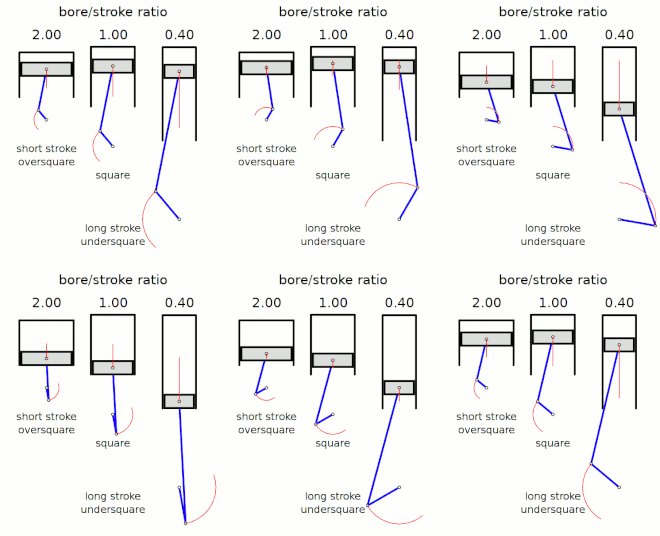
220px-Bore_Stroke_Ratio_Animation.gif
 
Last edited:
Long stroke have a high piston speed and therefore max out at lower rpm and tuned for better torque. You want high hp you have to spin it and shorten the stroke.
Depends on the riding you do but marketing and high hp numbers sell bikes whether thats whats best for you or not.
 
Long stroke have a high piston speed and therefore max out at lower rpm and tuned for better torque. You want high hp you have to spin it and shorten the stroke.
Depends on the riding you do but marketing and high hp numbers sell bikes whether thats whats best for you or not.

Absolutely. It makes me sad too. I'd love a low revving, reliable 450. I don't need more than 45hp.
 
I honestly can't comment on rod ratio vs engine vibration, but I have personally manipulated rod ratios in Harley engines and Small Block Fords. Another interesting engine factor is rod length. The relationship of the 3 has incredible effects on power delivery with interesting trade offs in durability. I do know that large bores mean large, heavy pistons, which means lots of weight flying around. Usually offset with counterbalancers that sap horsepower.
The thing I dislike about long stroke engines is the piston speeds attained, especially on smaller displacement engines. Horsepower still correlates with rpm, and the faster you can spin any engine, the more HP you can make. Combine that with fast piston speeds on a long stroke engine and you get a short bottom end life, but good power. The flip side of the short stroke high revving engine is a no torque screamer that ends up with bore wear.
Try moving the wrist pin up in the piston and having a shorter skirt. Keeps the piston at TDC longer and delivers more power at lower rpm's, but renders the bore destroyed fairly quickly.
I don't hot rod singles, but the Vtwins I ride both have undersquare rod ratios, and it tends to give a fairly "hard hitting" power feel. There's obviously a lot of cam profile and combustion chambers design involved in the tunes as well.
 
Last edited:
2016 KTM 350 EXC, ; 88mm / 57.5mm = 1.53
2016 Husky FE350S; 88mm / 57.5mm = 1.53
2017 Beta 350 RR-S; 88mm / 57.4mm = 1.533

‘90-‘01 Suzuki DR350; 79mm / 72.1 = 1.096
‘96 Honda XR 400; 85mm / 70mm = 1.214
‘05 Suzuki DRZ 400; 90mm / 62.6 = 1.438

bore/stroke ratio calculator:
https://www.vcalc.com/wiki/KurtHeckman/bore+stroke+ratio

Absolutely. It makes me sad too. I'd love a low revving, reliable 450. I don't need more than 45hp.

2007 KTM 450 XC-W; 89mm / 64mm = 1.391; 42 hp/37.5 ft-lbs. torque

“2007 was also the last year of the RFS motor. The RFS is very torquey and is known to have very good reliability. In some cases, the fully stock engines last for more than 45k miles. The RFS bike is known to be a good dual sport and super motard bike. The wide ratio 6-speed transmission will run all day long on the highway. Due to their dual-sport ability, there are larger aftermarket fuel tanks available (11~26L).”

“KTM took a different approach to the configuration of the RFS motor than most other manufacturers. While others used a 90mm-plus bore piston with a very short stroke of 60mm, the KTM RFS motor used an 89mm x 64mm configuration which provided more torque at the expense of higher RPM's.”

KTM 450 EXC history:
https://www.revolvy.com/main/index.php?s=KTM%20450%20EXC&item_type=topic

Kawasaki KLR 650; 100mm / 83mm = 1.205 (bore/stroke ratio comparable to XR400’s 1.214)
... what I ride/prefer ... :ride

I’m thinking another reason most four-valve
engines are over-square is in order
to help give the valves room/keep
them away from the cylinder walls
so they can flow the most intake/exhaust ...

I have a couple of two valve bikes, both undersquare:
‘85 H-D FXSB Evo; 3.498 inch / 4.250 inch = 0.823
‘73 Triumph Tiger: 76mm x 82mm = 0.927

... no one would accuse either of
those engines of being smooth ... :laughing

Yamaha WR250r; 77mm / 53.6mm = 1.437
KTM 640 ADV LC4 engine; 101mm / 78mm = 1.295
Lyndon Poskett’s 732cc LC4: 105mm / 84.5 mm = 1.243
... some other bikes I’ve been thinking about ...

... be interesting to hear from people
who’ve ridden both the KTM and Beta 350s (and maybe a WR250r) ...
I suspect there’s a ton of things that
impact a rider’s experience on a bike other than the b/s ratio ...
for example the DRZ and KTM RSF each have a similar b/s ratio,
but the ‘07 KTM’s wide ratio trans and 6th gear put it in a different league ... :dunno

... fun to think about ... :teeth

:thumbup:party
 
Last edited:
Fun subject.

More stats -


SR 500 - 88 x 84

SRX 600 - 94 x 84

DR 650 - 100 x 82

XR 650 - 100 x 83

KTM 690 - 102 x 84.5

BMW F650 - 100 x 83
 
the XR400 is significantly oversquare: 85mm bore, 70mm stroke.

the KTM 350 is even more oversquare: 88mm bore, 57.5mm stroke.

I'm not sure where you got your numbers...


I think a lot of the vibrations have to do with how much of a counterbalancer they use: if you use a bigger/heavier one (and bigger/heavier flywheels), you can get a smoother engine but the bike doesn't rev up as quickly or turn as easily.
 
hp=(torque x rpm)/5252

That's about all I know about this topic. But I suspect I'm going to learn some good stuff.
 
I like 'em lumpy-ish.

VTR motor would have been perfect if it had just a slightly shorter stroke. Pretty dam usable motor.
I rode an RC51, that came close to perfect as well, but the ergos were flat out cruel.
 
As with rod ratios, the geometric relationship between bore and stroke can also affect an engine’s power and RPM potential. Even so, such generalities often don’t hold true across the spectrum of production engines or engines that are purpose-built for racing.

As a general rule, large bore, short stroke engines are high revving, high power engines good for road racing and circle track applications. Pro Stock racers also like this combination for drag racing as do NASCAR engine builders. Small bore, large stroke engines, on the other hand, are better for low RPM torque, street performance, towing and pulling, but have limited RPM potential.

... fun article on rod ratio and b/s ratio:
http://www.enginebuildermag.com/2016/08/understanding-rod-ratios/
 
oddly enough they appear to be the same bore (100mm) with slightly different strokes (82.6 for the R, 82 for the L)
Stock XR650L is 644 CCs, Stock XR650R would then be 648.7 CCs. Mine has a larger bore and is 675.4 CCs.
 
SR 500 - 88 x 84

SRX 600 - 94 x 84

DR 650 - 100 x 82

XR 650 - 100 x 83

KTM 690 - 102 x 84.5

BMW F650 - 100 x 83

2016 KTM 350 EXC, ; 88mm / 57.5mm = 1.53
2016 Husky FE350S; 88mm / 57.5mm = 1.53
2017 Beta 350 RR-S; 88mm / 57.4mm = 1.533

‘90-‘01 Suzuki DR350; 79mm / 72.1 = 1.096
‘96 Honda XR 400; 85mm / 70mm = 1.214
‘05 Suzuki DRZ 400; 90mm / 62.6 = 1.438


2007 KTM 450 XC-W; 89mm / 64mm = 1.391; 42 hp/37.5 ft-lbs. torque

Kawasaki KLR 650; 100mm / 83mm = 1.205 (bore/stroke ratio comparable to XR400’s 1.214)
‘85 H-D FXSB; 3.498 inch / 4.250 inch = 0.823
‘73 Triumph Tiger: 76mm x 82mm = 0.927

Yamaha WR250r; 77mm / 53.6mm = 1.437
KTM 640 ADV LC4 engine; 101mm / 78mm = 1.295
Lyndon Poskett’s 732cc LC4: 105mm / 84.5 mm = 1.243

the XR400 is significantly oversquare: 85mm bore, 70mm stroke.

the KTM 350 is even more oversquare: 88mm bore, 57.5mm stroke.


two more dual-sports for comparison...

RXV450 76 x 49.5 (x2) ~60hp 1.53 ratio
RXV550 80 x 55 (x2) ~70hp 1.45 ratio

:party
 
Last edited:
Just for reference, I took some #'s off the internet (may/may not be exact.. but close)

Yamaha R6; 67 x 42.5mm- 1.58, redline 16.5K

Harley aircooled: 4.016 x 4.5"- .89, redline 5.8K
 
Do you prefer a long or short bore/stroke ratio on a dirt bike?
A preference is going to be based on how the person responding rides and would not be relevant to someone who enjoys a different style of off road riding.

Personally, having grown up on MX two stroke bikes, I want a snappy, high revving dirt bike. I'm not in the habit of lugging the bike up a hill and prefer to spin it for hills and every place else for that matter.

My preference, short stroke.
 
I think a lot of the vibrations have to do with how much of a counterbalancer they use: if you use a bigger/heavier one (and bigger/heavier flywheels), you can get a smoother engine but the bike doesn't rev up as quickly or turn as easily.

that.

im sure the engine designers do a cost-benefit analysis before implementing any vibration adjustment.
 
Take a look at V-Twin balance factor calculations and the effect they have on vibrations if you want to get deep into the why or why not to counterbalance an engine.

Beyond the rod ratio, piston speeds affect volumetric efficiency, which plays into power delivery. Saying an undersquare rod ratio will be torquey is not a hard and fast rule. Port design, valve size, throttle body size, plenum volume, and cam profile all play into that.
 
Beyond the rod ratio, piston speeds affect volumetric efficiency, which plays into power delivery. Saying an undersquare rod ratio will be torquey is not a hard and fast rule. Port design, valve size, throttle body size, plenum volume, and cam profile all play into that.


No, but more often than not, it proves to be the case.

In my experience, under-square engines are tuned for torque and have lower hp figure when compared to similar displacement configurations. Just like you said, longer stroke = more bottom end wear if you spin them fast.

Undersquare, long stroke engines are often my go-to for street bikes. They often provide that user-friendly power and drive that you want in every situation. Sadly these same bikes often lack that excitement factor that short-stroke engines provide. For me, it's either one or the other, that happy medium often is as bland as long stroke and nowhere near as exciting as a over-square engine.

Pretty much any 4T liquid cooled dirt bike is going to be undersquare or square'ish. These are more or less race bikes... Cause race bikes.
CRF250X 78mm x 52.2mm VS CRF250R 76.8mm x 53.8mm
Those few mm really wick up piston speed in the 250R's.

But let's not leave out flywheel weight... That also plays a HUGE role in this conversation.
 
Last edited:
The ideal bore-stroke ratio for dirt bikes was figured out in the 1990s. All competitive 250cc dirt bikes used and continue to use the undersquare 66.4 x 72 mm.
 
Back
Top