• There has been a recent cluster of spammers accessing BARFer accounts and posting spam. To safeguard your account, please consider changing your password. It would be even better to take the additional step of enabling 2 Factor Authentication (2FA) on your BARF account. Read more here.

Losing the front?

ctwo

Merely Rhetorical
Joined
Feb 5, 2015
Location
auf der motobahn
Moto(s)
motato
Name
Heyou
I haven't been able to get my bike all the way down.

Do you guys remember those LeanTo pegs? I think I'm getting pretty close but haven't found the pegs yet.

It feels like the front is starting to loose traction, the tire starts to slip wide, and the front feels like it's starting to drop.

I was reading discussion about low side vs. a tuck. I don't know if that's just all about semantics or if there is some key difference in how to approach each issue.

What am I doing during this? I have tried various things such as carrying more speed into the corner and using light front brake, rear, both

or entering as usual or a bit hot and use more throttle control, either engine braking or light acceleration. I've read numerous times that adding throttle is how you crash, but I think most there are having high sides?


Here was an example of a tuck. And BTW, they did not seem to know why the tire turns inward. I think that happens because there are rider inputs turning the bars and when the tire looses traction, those inputs turn the bars further in.

I am feeling the loss of pressure and usually then is when I'll start gingerly off the throttle and relax the bars, let it go a little wide, apply rear brake if needed, and then pick up the throttle as I'm exiting.

 
Huh?

There’s no appreciable diff btw front lowside and tuck.

Applying throttle / causing acceleration shifts weight rearwards, which is off the front tire. Doing this while near a cornering limit can be a great way to cause the front tire to tuck. That’s why we must remove lean angle and/or open the turning radius before accelerating when near limits. Ya, if you turn throttle fast, you can spin the rear before the weight transfers and highside. It’s always a timing thing.

The front tire turns inward when it tucks because the contact patch is inside of the steering axis. When the centripetal force goes away, you still have some force at the contact patch that causes a torque around the steering axis. The direction of the torque is inwards because of the location of the contact patch.

Lean angle == corner speed & turning radius. If you want to get lower, you need to increase speed or decrease radius. If you are struggling to decrease radius, you inside arm is probably too stiff.

Grip == tire heat & pushing the tire into the ground. The front brake is the main cause of both of those for the front tire. Trail brake better to keep the front tire hot and increase front grip. Releasing the front brake suddenly will take weight off the tire and may cause a slide.
 
Are you trying to lose the front completely or just "push" into the corner? At lean, different tires/ bikes will have different cues, but they're similar. On Pirelli's on a track bike, the front inside bar will get very light and give a wag at the bars. A low side is the same as tucking the front. 'Tucking the front" is more descriptive. If you're losing the front, you'll need to take some load off the front to get the bike to hook back up....loose arms and breathing helps here IME.

The tire turns inward when it loses traction because the mass behind the front tire (pushing the motorcycle) is larger than the mass in front of the headstock. The inverse is true when a rider loses the rear (in a corner).
 
Loosing the front is rider error...

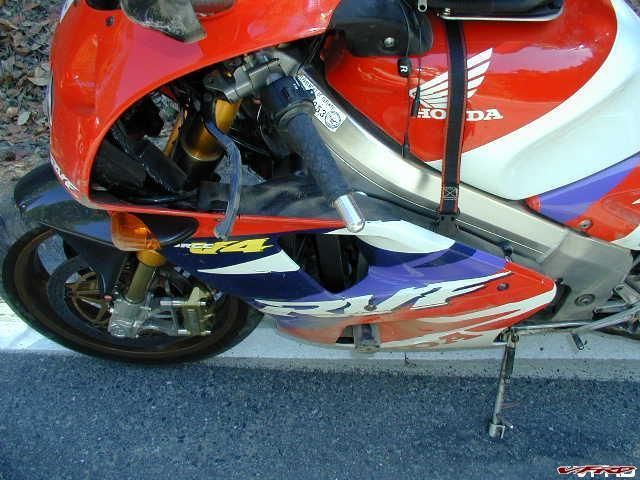
2013 Highway 36 Northern California... I tossed my RC45... I failed to notice a
patch of black sand on the asphalt... Mercy... I laid some very expensive marks
on old H36... boy was my face red!!!

h36crashperspective-jpg.37048

h36crashfrontrennsport-jpg.37049

h36crashrearrennsport-jpg.37050


No fun being your own crash test dummy but now I know how my home made stuff works... The
Delrin frame sliders... non folding billet aluminum foot pegs and solid billet handle bars were designed
as 3 hard points good for sliding down a track... I gave them passing marks for sacrificing themselves
in order to protect the aluminum tank and plastic...
gallery_3131_51_6926.jpg


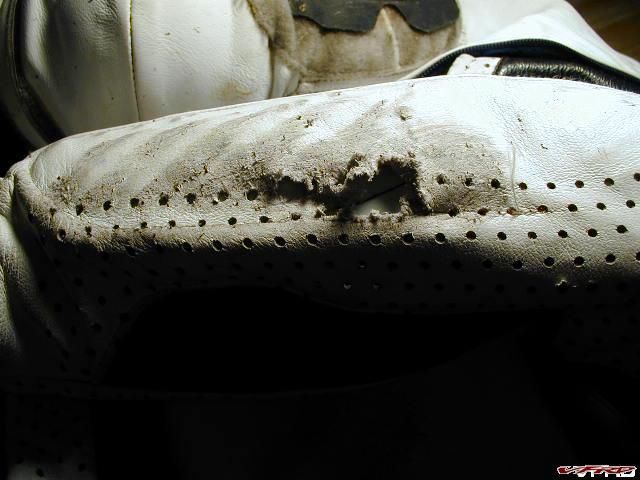
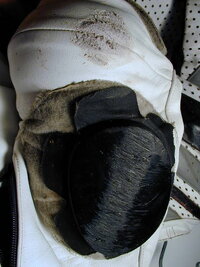
I hates messing up my gear
gallery_3131_51_39638.jpg

H36CrashKneeSlider.JPG

Since 1979 I've low sided on the perverted highway unexpectedly twice...

1980 Japan... a Japanese road crew had covered both lanes of the
Okatama Toll Road with automotive antifreeze... (no joke) they were on
a very misguided mission to keep the surface from freezing... ( I sued
for 10 million yen about 64K)

2013 Highway 36 Northern California... I failed to notice a
patch of black sand on the asphalt... boy was my face red!!!

I was up to 22 years without a environmental impact study but then a
patch of black sand on H36 reset the counter... MERCY!!!
MrRC45TahoeSweeperCloseUp.JPG
 
Last edited:
My initial take is your tires are old. That should not happen. Good tires properly inflated and warmed should get to pegs feeling the flow.
 
The diff of low side was explained as the back sliding out and going down similar to a tuck.
 
The bars always go light when over the limit of grip. The force that makes the bars stiff is how motorcycles function, how they use grip to keep the front tire tracking. When over the limit, that “tracking” force decreases and the bars are easier to turn. The same thing happens in low grip situations like riding in the rain.

IME this is the primary feedback mechanism for the front tire. The more locked in and stiff the bars feel, the more grip you actually have. This allows you to add more and more corner speed lap after lap. And when that feeling decreases, you’ve found the limit.
 
Slower speed, tighter corners have a different feel than higher speed corners, WRT to bar feeling. I've not had much warning when losing grip in slower corners....and lost the front completely on those corners more often than longer, quicker entries. Creeping up on grip is easier with longer entry corners IME.
 
"Had we been riding tards or enduros instead of those awful spr0tbile things, we could have aimed for the sand and had a good ole time instead of crying out for momma and throwing ourselves down the road."

- Hunter S. Thompson, "Fear and Loathing on 36"
 
"Had we been riding tards or enduros instead of those awful spr0tbile things, we could have aimed for the sand and had a good ole time instead of crying out for momma and throwing ourselves down the road."

- Hunter S. Thompson, "Fear and Loathing on 36"

SportBikes are only awful at lawful speeds...

I remember kicking and wicking my street legal trusty Husky and having a good ole time aiming for the sand...

250HuskyElMirage.JPG
250HuskyEnsenadaMexico.jpg
 
Last edited:
I'm not running track time, just where it seems OK on the street. For example, I should be able to drag some pegs around a cloverleaf.
 
I hate the impact zones on the street. Dragging pegs isn't an issue...it's losing traction on the street that I want nothing to do with. My tolerance is low for that stuff, probably cause I see trajectories when I ride given my low side history on track.
 
Let's keep this focused on answering the original question and not on crash damage / analysis.
 
I'm not running track time, just where it seems OK on the street. For example, I should be able to drag some pegs around a cloverleaf.
A couple thoughts enter my head when reading this post.
  1. When foot pegs touch the ground that means less weight and thereby less traction on the tires.
  2. What speed do you think you'll be going when you want to scrape the pegs? 40mph? Consider that the traction needed at 40mph is four times (4x) what is required at 20mph. Can you realistically judge that there is that much traction available in the cloverleaf at that moment?
 
A couple thoughts enter my head when reading this post.
  1. When foot pegs touch the ground that means less weight and thereby less traction on the tires.
  2. What speed do you think you'll be going when you want to scrape the pegs? 40mph? Consider that the traction needed at 40mph is four times (4x) what is required at 20mph. Can you realistically judge that there is that much traction available in the cloverleaf at that moment?

1. Perhaps. I've ridden a lot of bikes and surely over 500k miles. Most of that of course young reckless kid just doing what he can. In most cases it wasn't a problem touching down. The pegs are on hinges or my foot would contact the ground first. I've had some upsets when frame bits touch, but should have the control to drag at leisure.

2. My X-11 (you'll look that up and discover it's just a citation) could rip 65 around cloverleafs at throttle all the way, if I went in fast enough. I'm not doing that on my bike. Realistically, I don't think anyone can judge how much traction any piece of pavement offers at any given time. Who knows if the pervious time around the track at that corner didn't have the coolant spray it now has? I think we rather ride on our experience and faith that the experience will more or less be repeated each time, unless we see otherwise.

It's my commute I've done over 7000 times now, so I know every snake, pothole, and grind mark, and all the obstacles around... I'm probably over a lot more than I think I am, but I am continually surprised I am not feeling it before the tire feels like it's letting go. I'll make a note of my speed when I hit it in a few minutes, and I'll try to pay attention if the weight/feedback on the bars seem to be getting light, depending if there are other commuters at the time.

I will say this bike takes more effort in the turns compared to the cruiser I was riding before. I did notice though that dropping my inside shoulder and leaning more forward toward the inside grip seemed to improve the cornering. No, I'm not hanging off the edge of my seat. I should be able to sit straight like a stick and drag parts.

Oh, most of the opportunities for me to push it are right hand turns, my weaker/less confident side.
 
You may know every pothole and tar snake, but you can’t know about the big rig that left a nice little line of diesel all the way around on the line you decided to ride that day. Or a car with a leaky radiator dripping coolant. I’ve seen it firsthand - a buddy of mine sliding down an off ramp on a one-inch wide streak of diesel. Another buddy wicked it up on an onramp that appeared to have some dirt on it. Turned out it was honeydew from a pump out truck or something. Down he goes for sh*tbucket sleighride. His new nickname after that was Slider.

Ever thought about trying on a track?
 
Back
Top