• There has been a recent cluster of spammers accessing BARFer accounts and posting spam. To safeguard your account, please consider changing your password. It would be even better to take the additional step of enabling 2 Factor Authentication (2FA) on your BARF account. Read more here.

Resource Conserving oil.

bunnygoat

Active member
Joined
Feb 27, 2004
Location
Oakland
Moto(s)
950SM
Name
Dan
Just noticed oils no longer say "Energy Conserving".
"Resource Conserving" is now used.
Its confusing and a search of its meaning (moly additives=clutch slip) reveals nothing definite.
Used to be only synthetic oils were labeled Energy Conserving and were avoided for bikes but now I see conventional products saying Resource Conserving.
Oreilly's Synthetic's the oil in question. anyone use it?
 
Ixnay using any Energy Conserving rating oil with motorcycles. At least any motorcycle with a wet clutch. Dry clutch bikes maybe but why go there?

mjlqq0.jpg
 
Probably.

And I certainly wouldn’t use an O’Reillys branded product.
 
Manufactures warn against it and owners are leery of it but Energy
Conserving/ Resource Conserving are not additives... its an API test that this
"oil MAY result is an overall saving of fuel in the vehicle fleet as a whole"...
there is nothing new in the oil to defeat a wet clutch...

What is confusing the issue is the fact that all motorcycle wet
clutches will reach a point in their life and start to slip EC oil or
non EC oil... have you noticed that no one complains about clutch slip
when the bike is new??? its around the 27K to 57K range as normal
containments build up to point you may find the clutch begins to loose
its grip... this is usually discovered by the owner during WFO (Wide
Fooking Open)throttle like during a quick overtake or at a track
day... in error one can blame the EC oil but its really the
contaminants on the clutch plates...

Mr.RC45 has over 57K miles and those are miles not in moderation either...
since 98 I've been running Mobil 1 5W30 Energy Conserving oil 365 days a year...

Mobil 1 5W30
vmSFajJ.jpg
[/B]
 
Last edited:
Thanks for clearing that up.

You're welcome...

Virgin Oil Samples of Honda 10w30 and Mobil 1 5W30 API SN EC oil list anti wear additives that are wet clutch compatible...
 

Attachments

  • VoaM1versusGN4.jpg
    VoaM1versusGN4.jpg
    50.3 KB · Views: 227
Last edited:
Manufactures warn against it and owners are leery of it but Energy
Conserving/ Resource Conserving are not additives... its an API test that this
"oil MAY result is an overall saving of fuel in the vehicle fleet as a whole"...
there is nothing new in the oil to defeat a wet clutch...

"Energy/Resource Conserving" is a specification, the oil companies may or may not use additives to achieve the required specifications.

I too have run Energy Conserving oil without clutch issues, but since the bike manufacturers recommend not too and plenty of non EC oil is available I don't see much reason too, especially since you often can't easily confirm what the additive package is for any given oil, and it may change over time.
 
I too have run Energy Conserving oil without clutch issues, but since the bike manufacturers recommend not too and plenty of non EC oil is available I don't see much reason too, especially since you often can't easily confirm what the additive package is for any given oil, and it may change over time.

I agree... the notion EC oil causes clutch issues is on shaky ground and the
manufactures are not helping when their owners manual warns about Moly but
their name brand approved oils contains Moly...

You can easily confirm what the additive package is for any given oil by a virgin oil lab analysis...

https://www.blackstone-labs.com/?se...abs.net/Bstone/(S(1ystx3m2xoh4pv55lvooief1))/
 
Last edited:
Thanks for clearing that up.

From: https://www.oilspecifications.org/articles/api-sn.php

The Resource Conserving supplemental category requires further properties. The former supplemental category, which was called Energy Conserving required only fuel saving properties from the oil. Resource Conserving requires further properties like:
• emission system protection
•turbocharger protection
• compatibility with engines operating on ethanol containing fuels, up to E-85


So if you believe Energy Conserving is bad, Resouce conserving is no better.
 
So if you believe Energy Conserving is bad, Resouce conserving is no better.

Thanks I saved your quotes...

I believe there nothing to fear about Mobil 1 EC or RC oils... because of all the
elements listed in the virgin samples not one is known to defeat our wet
clutches in good operating order... if your clutch is loosing its grip check for
high mileage and normal contaminants...

There is a time tested way to save $$$$$$ in new clutch parts by investing
in some sweat equity... deglazing clutch plates ain't nothing new... no sir...
back in the 70s it use to be part of every savvy rider's maintenance plan...
and for some reason that all change during the 90s... why fix what you can
buy new is the what you hear now a days... but if your interested in making
your clutch bite good as new then roll up your sleeves and read on...

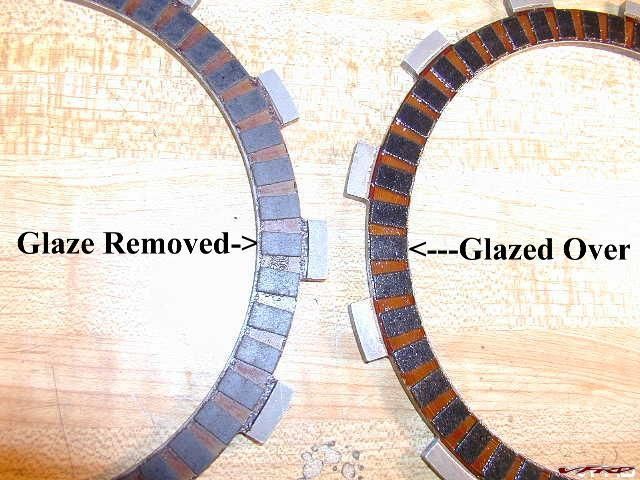
Inspect the friction plates for glazing... make sure you have plenty
of material to work with...

First removed the contaminants with something like Acetone... then lay
each plate over a 600 grit black dry emery paper and rotate in a
circle... you're just busting the glaze... don't get carried away
remove too much material... You should end up with a friction plate
looks dull like a new one as opposed to a shinny glazed one... recheck
thickness...
gallery_3131_51_129667.jpg


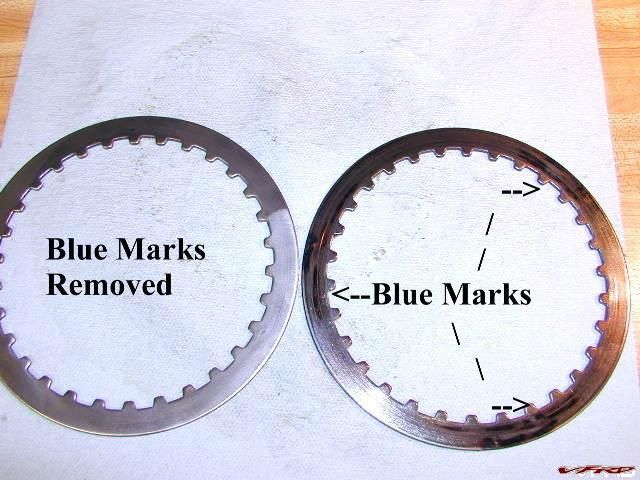
Next check the pressure plates for bluing caused by localized heat...
make sure they are not warped... check manual for a stated thickness
range... now removed the contaminants with something like Acetone
and wire wheeled them to erased the blue and also to generally scuff
up the surface... you should end up with a dull surface free of Blue
marks...

gallery_3131_51_40098.jpg
 
^^^^ great post! :thumbup:thumbup:thumbup

and if you'd rather not do the work above, or mechanically challenged, you can always just buy a new set of plates. About $15 each for the fibre's, & $7 for the steels. Need 9 fibers for my Kawasaki ZRX1200.

Most people like Barnett (they been around forever), or you could always get OEM. I like Barnett meself:
http://www.barnettclutches.com/658/kawasaki/0/0/2002-kawasaki-zrx1200r-zr1200.html
 
^^^^ great post! :thumbup:thumbup:thumbup

and if you'd rather not do the work above, or mechanically challenged, you can always just buy a new set of plates. About $15 each for the fibre's, & $7 for the steels. Need 9 fibers for my Kawasaki ZRX1200.

Thanks Dave... either way have a new clutch cover gasket ready to go if the old one tears...
 
Back
Top