

This past week I replaced the bearings in my VStrom 650 (the greatest motorcycle ever produced). Upon preloading the bearings, I was faced with an interesting predicament. Due to the way the steering bearings are tensioned, using a lock-nut system, the tightness of these locknuts is critical. Too tight, and the bike will handle very strangely - tending to fall over in the turns and having generally scary handling. Too loose, and it will clunk. The difference between too tight and too loose is a mere few degrees of rotation on the preload nut. Further, due to backlash in between the nuts and steering tube threads, the tightness of the upper lock nut against the lower lock nut significantly changes the preload on the bearings. It takes a trained mechanic or lots of experience to get the right feel for the sweet spot. The service manual specifies a handlebar force that can be achieved through trial and error.
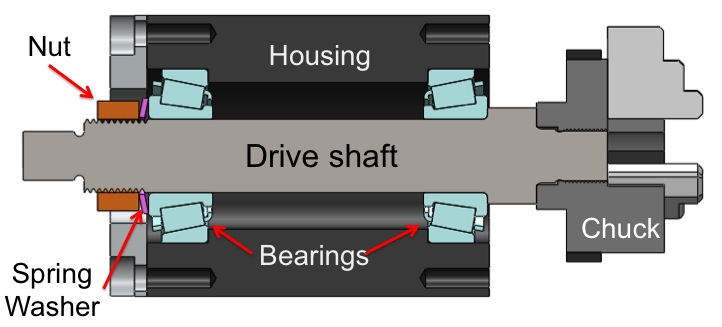
This got me thinking. What are your thought on introducing a belleville spring washer into the system between the upper bearing inner race and the lower lock nut? This way, it would allow for 1/4-1/2 turn of "spring" before bottoming out, and allow a tightness range rather than one correct tightness.
In the standard setup, the tension preloading the bearing comes from stretch in the threads of the steering tube, stretch in the nuts, and microscopic stretch in the steering tube itself. This "spring" is extremely stiff, so a few degrees of nut rotation can mean the difference between 5lbs of preload and 500lbs of preload. A belleville spring washer with the correct rate would allow a range of say, 20-50lbs across 180 degrees of nut rotation.
This is a common practice in thousands of industrial bearing applications, even in some high speed CNC spindle bearings that require very specific tension and high precision. Yet, motorcycles don't do it. Any ideas why?
Just like this:
This got me thinking. What are your thought on introducing a belleville spring washer into the system between the upper bearing inner race and the lower lock nut? This way, it would allow for 1/4-1/2 turn of "spring" before bottoming out, and allow a tightness range rather than one correct tightness.
In the standard setup, the tension preloading the bearing comes from stretch in the threads of the steering tube, stretch in the nuts, and microscopic stretch in the steering tube itself. This "spring" is extremely stiff, so a few degrees of nut rotation can mean the difference between 5lbs of preload and 500lbs of preload. A belleville spring washer with the correct rate would allow a range of say, 20-50lbs across 180 degrees of nut rotation.
This is a common practice in thousands of industrial bearing applications, even in some high speed CNC spindle bearings that require very specific tension and high precision. Yet, motorcycles don't do it. Any ideas why?
Just like this:


