• There has been a recent cluster of spammers accessing BARFer accounts and posting spam. To safeguard your account, please consider changing your password. It would be even better to take the additional step of enabling 2 Factor Authentication (2FA) on your BARF account. Read more here.

Who's gone Solar

I don't see what the big deal is. With high speed rail, everyone will save time and money- more than enough to make up for some silly sun energy loss. Certainly, it will be up & running by end of the year!

 
I gotta remember byke knows this shit.
 
Lawsuit before the California Supreme Court to overturn NEM 3 and return to NEM 2.


The CPUC’s decision, which went into effect in April 2023, said the change sends “more accurate price signals that encourage electrification” across the state.

The commission determined that changes need to be made, agreeing in large part with California utilities who said the earlier NEM rules were too generous.

They argued that the growing number of rooftop installations leads to a “cost shift” that leaves customers who don’t have solar paying an unfair share of the fixed costs that come with maintaining the electric system — substations, transformers, poles and wires, etc.

But opponents of the CPUC decision have long disputed the cost-shift argument, saying that it does not properly take into account the benefits of rooftop solar, such as reducing the need for utilities to spend ratepayer dollars on building more infrastructure.
 
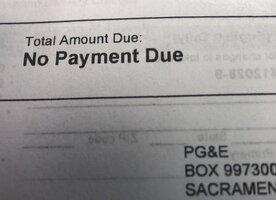
I am paying my PG&E bill right now. Elect is $8.87 plus the monthly thing...
 
I am paying my PG&E bill right now. Elect is $8.87 plus the monthly thing...
The last bill I got, April, was negative $28 for electric and negative $7 overall.

YTD monthly average is $11 electric, $41 total.
 
Never get tired of this-
 

Attachments

  • pge4.jpg
    pge4.jpg
    38.1 KB · Views: 78
My first true up was - $863.26. After that was wholesale exchanged, .003c per kwh (SCE), and with the next month (1 of 12) charges it turned into - $124.32.

As of right now i am month 6 of 12 and sitting at - $455.76

This year will do my best to crank that a.c. to sit as close to even at true up.

Well Im NEM 2 and based on that article it says NEM1 and NEM2 programs the utility buys back at retail rate. In my case they arnt, unless theres something im not understanding about the program. Unless my generation is calculated monthly at a retail rate and the YTD credit true up is paid at a wholesale rate. That would make sense. Maybe i should learn how to read the bill.

Im month 9 of 12 right now and sitting at -658.81. Last month i was -734.00 so if figured i better really get comfortable. Ben cranking the AC down to 70 in peak hours when were home until 11:30 pm.
 
Unless my generation is calculated monthly at a retail rate and the YTD credit true up is paid at a wholesale rate.

This is how it works for version two and version one.
 
I'm pulling the trigger on a couple of house batteries to (somewhat) insulate myself from blackouts. I already have panels on my roof which were purchased upfront (no lease bullshit or anything).

Most of y'all are much smarter than I am so I need some advice:

The quote I'm leaning towards includes an HDM agreement where a finance company 'owns' the batteries for 6 years and collects the tax credits; I get an immediate discount on the batteries and ownership automatically transfers to me at the end of the term.

I have zero issues with someone else taking the credits in exchange for my cash payment up front but my inherent mistrust of for-profit companies gives me pause at the idea of the batteries not being officially mine.
To be clear, I'm not very concerned if I "lose" a bit of money via tax credits in the long term. The ownership angle is my main issue.

Am I being paranoid for no real reason?
 
Read the contract.
Talk to other customers of the company who did the same deal.
What is the O&M obligation of the company during and after the 6 years?
What type of batteries?
Are they installing a critical loads panel or powering the whole house in a blackout?
 
1) done.
2) done-ish? read reviews and descriptions online and decided I'd ask for advice here
3)
4) enphase 10C
5) my understanding is that batteries can either A) off-set power demands or B) provide house power when the grid fails. I asked the company that installed the panels for a quote, then shopped around for comparisons. I'm using the installer's quote as a reference regarding equipment needed.
 
My understanding is batteries also help offset being screwed over by PGE changing the net metering rates, so if you're generating more than you use the batteries store it rather than selling it back to PGE for 1/20th of what its worth?
 
It's been a while since I worked in the space, so things have advanced and changed, I am sure the power controls are a little bit smarter than they were back in the day, but regardless of how smart controls have become, there are still a couple of basic ways battery backups can work.

As you mentioned, they can provide power (just like the grid or a PV system) to power your loads directly, (usually when electricity costs are at their highest If you have a time of use rate plan) then you recharge the batteries off peak mid day with PV power.

In a blackout, grid tied PV and battery systems have to disconnect automatically from the grid.

This is done at the inverters with a standalone PV system (They have to sense AC voltage in order to operate, once the AC grid goes off they shut off until it returns)

With battery systems or automatic generators, They also have sensing of the grid, so if the grid goes down they isolate their power generation from the grid and will provide their power directly to the house load.

But how this is accomplished can vary.

If the system is sized large enough, it can provide power to the entire house through the main panel just like the grid did and things will automatically transfer when the power shuts off and comes back on.
Other times if it is a smaller system it cannot power the entire house, so some critical circuits are pulled into a standalone panel called a critical loads panel and the generator or battery is just feeding those. (Heating circuits, some outlets, fridge, etc)

Important to know what they are providing you regarding that
 
Last edited:
I need a new controller box but my existing combiner was originally chosen with the battery upgrade in mind.

One Enphase 10C would have been somewhat sufficient but two of them will ease my mind. Tesla offers a 13kWh that would have worked but I chose not to use that because reasons.
 
  • Like
Reactions: GAJ
Size of the battery bank is just one consideration.

What are the batteries doing for you? That is the functional question for the "value" of the system.
Just buying a bunch of batteries is a fixed hardware cost, that is straightforward to cost out and compare.

Is it being programmed to charge and discharge daily to provide kwh usage arbitrage?
What is the expected savings? What is the life cycle cost on the batteries and their replacement under such conditions?

Is it merely an emergency backup for blackouts?
is it powering the whole house?
 
Last edited:
Apologies for my poor communication skills.

This will be to somewhat insulate myself from PG&E power outages. I say 'somewhat' because I'm not fooling myself into thinking I can be disconnected from the grid for any great length of time; but I should be able to survive a few days while the neighbors suffer quietly.
I would obviously minimize usage while on battery-only power but keeping the house at a reasonable temperature during a middle-of-a-heatwave blackout is near the top of my priority list.
Original installer said a single 10C might be / should be enough but air conditioning start cycles would be the main issue., so two batteries it is.
 
Apologies for my poor communication skills.

This will be to somewhat insulate myself from PG&E power outages. I say 'somewhat' because I'm not fooling myself into thinking I can be disconnected from the grid for any great length of time; but I should be able to survive a few days while the neighbors suffer quietly.
I would obviously minimize usage while on battery-only power but keeping the house at a reasonable temperature during a middle-of-a-heatwave blackout is near the top of my priority list.
Original installer said a single 10C might be / should be enough but air conditioning start cycles would be the main issue., so two batteries it is.
You might want to look into soft start for your AC unit. I think its a fairly simple upgrade something like adding a capacitor maybe but it keeps it from pulling a gazillion amps on startup. I might look into it again because it would also help to run it off a generator when we have hurricanes down here.

edit: I was wrong its some kind of electrical device but it does lower inrush current by up to 70% and it's a few hundred dollars. Going to talk to my AC guy when I have a few free minutes about doing it to my house.
 
Back
Top