• There has been a recent cluster of spammers accessing BARFer accounts and posting spam. To safeguard your account, please consider changing your password. It would be even better to take the additional step of enabling 2 Factor Authentication (2FA) on your BARF account. Read more here.

Helmet color and visibility

There are studies, this is the first one I found that covers color, before that it was comparing bright colors to black gear and helmet and it was about a 20% reduction in accidents.

These seem to come out of New Zealand a lot, I think they fund these kinds of studies more than our government does.

This one is interesting because they did study color, and found that white, hi-viz yellow, and hi-viz orange all provided about the same benefit over a black helmet:

https://www.motorcyclistonline.com/study-bright-colors-save-lots-motorcyclists-lives
 
Last edited:
Sooooo. Does kurth83 get the 100 dollars?
Inquiring minds want to know!
It groups white with yellow and orange. It didn't say white was better, nor did is say the other colors were better, just that both were better than black. Did you read it?
 
[YOUTUBE]xotskfAm5_Q[/YOUTUBE]


I made this video in 2015.

This is how the motorcyclists look from the car driver’s point of view.

I am not trying to be a preacher, but wearing Hi-viz yellow or white gets you noticed better from other road users.
And wearing dark color gear, the rider / motorcycle blend into the background, easily becomes invisible.

(You can see it in the first two examples in the video. )

BTW, at the time when I made this video, I went to some local motorcycle shops, and asked why they stock only dark colored helmet.
(Roughly 80% of the helmets they stock are some sort of black (gloss black, flat black, gunmetal, that sort of thing). About 10 % are gray, sliver helmets. And than, a little bit of the graphic model. Solid white is almost non-existent.)
The answers were very simple. Everyone wants to buy  black helmet. (And matt black sells better than gloss black. Nobody wants solid white helmet, thus, they don’t stock them.)
When I look around, it seems right. The majority of the riders are wearing black or dark gray helmets.

Another interesting thing is that the all cruiser riders (in my video) who had female passengers, they equipped girls with t-shirt, skirt, no gloves, slip-on shoes, etc (basically no protective gear other than helmet).

Besides gear color, an important but often neglected thing is,

Dazzle Camouflage effect.


If you like black, then, that’s what you want to ride / wear, no matter what people say.
Solid black is actually better than the gear with too busy graphics.

Ever heard of “dazzle camouflage” ?

040f29d62cac78ca15a0e820424c4ef3.jpg


During WW1 and 2, they painted the ships with complex geometric patterns with contrasting colors. Dazzle camouflage is not about making ships invisible. It’s about disruption, confusion. It makes it difficult to judge the size and the shape of the target (ship), makes it difficult to judge the speed and the direction of the target, as well as the distance to the target.

http://io9.com/an-illustrated-history-of-unbelievably-camouflaged-ship-676257937

You can create the same effect with some motorcycle gear with “dazzling” graphics.

Better to wear, solid color gear, preferably your suit & helmet in the same color, no busy graphics / logos.

Solid white full face + Hi-Viz yellow Aerostich, with auxiliary lights.


[YOUTUBE]Yt9vOYwz5J8[/YOUTUBE]


Add some reflective material / auxiliary lights is a good idea,also.
 
Out running errands today and this thread popped into my head.

Waiting at a red light to make a left I noticed waaaay off in the distance coming towards me something white, noticed it before I had a clear visual of the bike the guy was riding (something in a Honda red color)
 
[YOUTUBE]xotskfAm5_Q[/YOUTUBE]

I made this video in 2015.

This is how the motorcyclists look from the car driver’s point of view.


[YOUTUBE]Yt9vOYwz5J8[/YOUTUBE]

Solid white full face + Hi-Viz yellow Aerostich, with auxiliary lights.

Add some reflective material / auxiliary lights is a good idea,also.
Both of those videos seem to reinforce what Harry Hurt said about helmet color:

The view of the front of the motorcycle and rider will expose very little of a helmet surface, unless the helmet is full facial coverage. The largest area exposed by a full facial coverage helmet is no more than one-fifth that of an upper torso garment. Thus expectations that color of any contemporary helmet can affect conspicuity should be low.

In his "Recommendations" Hurt addresses conspicuity but says nothing about helmet color:
In such cases [where view was not obstructed] it was clear that the increased conspicuity would reduce accident involvement. The data from this research are conclusive in the favorable factors to increase conspicuity: headlight on in daytime is highly effective, bright upper torso garments are helpful, while war surplus army jackets are deadly, and fairings and windshields apparently make the small profile of a motorcycle larger and more conspicuous.

MAIDS had nothing to say about helmet color and little to say about jacket color.

The limited results reported from the more recent (and embarrassingly lame) US Motorcycle Crash Causation Study said about helmets only that "Green was underrepresented in the crash data", i.e., green helmets were involved in crashes less often. Which amounts to jack shit. If helmet color does not contribute one way or the other and the data distinguishes enough different colors, just by chance some will be overrepresented and some underrepresented.

Regarding jacket color, MCCS found: Red was overrepresented while orange and brown were underrepresented in the crash data.
 
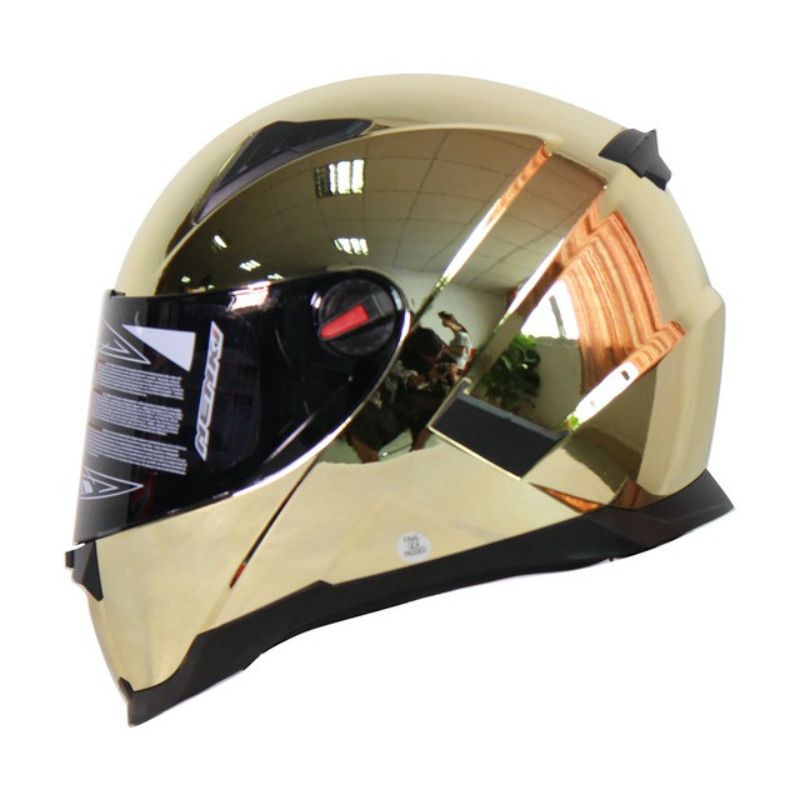
What about chrome? I kept one of ~these as my first helmet for far too long because so many drivers would pull up and tell me they could see my helmet from a distance.

chrome-racing-full-face-motorcycle-helmet.jpg
 
To add some info from scholarly sources (i.e. scholarly papers that have been peer-reviewed and published in a scientific journal),

Differences in Motorcycle Conspicuity-related Factors and Motorcycle Crash Severities in Daylight and Dark Conditions, Shaheed et. al., 2011

"Additional measures to enhancing conspicuity include wearing reflective or fluorescent clothing, wearing white or light colored helmets, ..." (1)

"A case study in New Zealand (Wells et al., 2004) showed that there was a 37 percent lower risk of motorcyclists getting into a severe traffic collision if the driver was wearing any reflective or fluorescent clothing and a 24-percent lower risk if the driver was wearing a white helmet instead of a black one." (3)

Attention and search conspicuity of motorcycles as a function of their visual context, Gershon et. al., 2012

"In urban roads, where the background surrounding the PTW was more complex and multi-colored, the reflective and white outfits increased its attention conspicuity compared to the black outfit condition. In contrast, in inter-urban roads, where the background was solely a bright sky, the black outfit provided an advantage for the PTW detectability." (Under the "Results" part)

There have also been a couple patents for helmets with LED stuff on them. Didn't read any scholarly articles about them, though, because I'm lazy.
2007 patent: https://patents.google.com/patent/US7932820B2/en
2014 patent: https://patents.google.com/patent/US20150250247A1/en
 
The tl;dr to my post above is that yep, white or light-colored helmets and reflective clothing is the way to go.
 
The beauty is statistics is that it can work in the favor of both sides or neither...At the same time! If you extrapolate your data to fit your desired outcome, it's not wrong. Just misleading.

Unless these studies are targeting eye movement and cognitive brain stimulus from drivers, it's sorta just a because I said so statistics. We know that bright/florescent colors catch the eye. That's not new. Just throwing numbers at it is not doing much.

Yay statistics!
 
people miss/don't see fire trucks. you know, ones that are much larger than a motorcycle. ...and with sirens going, lights blinking everywhere, etc.

they miss *THAT*.

you can wear any colors you'd like, just don't lie to yourself about it being safer. people don't look. if they dont look it doesn't matter what colors you got on you..
 
How many people don't run into fire trucks because they are hi viz?
Hi viz makes you more visible. Kinda hard to refute that. More visibility is a good thing. While hi viz is not 100% effective, it's another safety technique you can utilize.
 
I got the new helmet today. The fluorescent orange color is BRIGHT!

It should be especially good on overcast days.

Now I just need to wear it enough times to break it in so that it doesn't feel too tight. It feels very much like my other FX-39 was when new.
 
How many people don't run into fire trucks because they are hi viz?
Hi viz makes you more visible. Kinda hard to refute that. More visibility is a good thing. While hi viz is not 100% effective, it's another safety technique you can utilize.

sure, it all helps with people that actually look. if they all did that much then Id say there's value in this. but not all of them look, hence there's no value.

if 999 of them notice you - great, but it only takes that 1 that doesn't notice you. and he/she won't notice you if you're lit up like a christmas tree, so you should still ride like you're invisible & everyone is out to get you.
 
So lets paint all the fire truck black and remove their lights because that 1 out of 999 will still run in to you.
You're not getting it. Hi Viz doesn't make up for defensive riding, it enhances it.
 
So lets paint all the fire truck black and remove their lights because that 1 out of 999 will still run in to you.
You're not getting it. Hi Viz doesn't make up for defensive riding, it enhances it.

It probably enhances it to some degree in many, but not all situations. To what degree hasn't been determined in my opinion.

Many folks I've met riding around are wearing high viz hemets that don't fare so well in say the SHARP rating system done in the U.K. If the real concern is safety, then why wear a mid rated helmet?

I guess helmet safety, and how you test for it, and whether or not the new technology hemets like 6D and Bell's MIPS system are better.... probably needs a different thread, and I'm sure will have just as much disagreement :laughing
 
Okay, I'm not trying to thread jack, but ...

Regarding motorcycle safety gear, especially helmet, there are tons of misleading, misguiding info floating around on the net, so people should be careful what information to pick up, what to discard.

SHARP rating system is such an example.
It's quickly spread out in the online motorcycle community. Somehow, people liked it, believing cheap lower end HIC helmet is safter than Arai or Schuberth that cost 3 times more.
A lot of people still believe SHARP 5-star rated helmet is the safest helmet on the market, some guys buy "5-star" rated helmet that doesn't fit correctly, compress EPS liner by spoon or baseball bat in order to get rid of hot spot.

Don’t blindingly trust things you read online. Including SHARP helmet rating system.

SHARP helmet rating system is NOT a god send. It is flawed, just like any other system we have in this world.
Read the PDF file linked below, before taking SHARP rating as gospel.

http://www.birmingham.ac.uk/Documen...ftheSHARPmotorcyclehelmetratingsweb600150.pdf

Flaw #1
They always have the impact on the same place on the outer shell of the helmets they test. This does not take into account that different helmets sit differently on the head, meaning that the SHARP impacts are actually hitting different parts of the head (not the helmet) with different helmets.

Flaw #2
Because they always have the impact on the same place, for the manufacturer that produce cheaper helmet, it is very easy to produce a helmet that would score good in SHARP testing. (They know exactly which part of the helmet is going to be tested.)
Real high end manufacture spend time and money on R&D to develop the helmet that would protect the rider's head in the real world crush, rather than trying to get a good score at overly simplified SHARP test.
For the cheap helmet manufactures, this is a great way to advertise their product.

Flaw #3
You can read it in the PDF file above, but, in short, the SHARP test is fundamentally flawed because it utilizes a faulty model for accident mechanics, leading to an up to 300% higher chance of a deadly injury in the SHARP model compared to reality. Since they then award their stars on the basis of how many riders would die with that helmet if all riders wore it, that makes their star rating somewhat unreliable.

Flaw #4
If you live outside of UK, SHARP rating is pretty much meaningless as the test is done to the store bought helmet (in UK), therefore, the test result does not apply to the other market. (Helmet manufacturers sell different spec helmet from market to market, even if the helmet has the same model name.)

Example
A lot of people in US thought SHOEI RF-1100 was one of the safest helmet because it 5-star rated in SHARP.
The truth is, SHOEI RF-1100 is NOT 5 star rated helmet. It s XR-1100 that is tested in SHARP.
They look identical, but they are internally different. XR-1100 weigh only 1,350g, whereas RF-1100 weigh 1,746g.
RF-1100 is Snell 2010 rated, XR-1100 (both euro-market model and Japanese domestic model) is not.
The significant weight gain comes from making the helmet to pass Snell 2010.

Flaw #5
Remember how Marco Simoncelli died. (If you don't know who he was, do the goggle search.)


He was wearing AGV GP tech, which was rated 5 star in the SHARP rating system. And the helmet came off from his head because the chin strap failed.


[YOUTUBE]5_1M0ALL2eo[/YOUTUBE]


Same thing about "Snell vs ECE 22-05".
Quite a bit of people talk like "I prefer "softer ECE helmet" over the "hard SNELL" rated helmet.".
How many of these people have read the full test procedure of both tests?
99.9% of those people are just repeating what they have read somewhere on the net.

I'm not trying to argue, or bashing anyone.

 
Last edited:
Remember how Marco Simoncelli died.
Yes, unfortunately.

This is something I never have to see again in my entire life. I wish I've never seen it.

I'm curious as to the future of those other internal materials that let your head float about a bit more than the classic styrofoam that most helmets use today, and how they test in the current accreditation mechanisms. I eagerly await more studies in that field.

As for Hi-Viz, that guy in the bike videos above -- to me, on the video, the hi-viz became essentially white quite quickly as he went down range. I don't know if white would have gone gray.
 
I'm not trying to argue, or bashing anyone.

As I said, I'm sure we'll have just as much disagreement. Still, I believe discussions about helmet safety (especially given what is being learned as a result of football concusions and bicycle injuries) is more important [to me] than what color might be noticed by [distracted] drivers.

Most of my personal heart stopping incidents have been caused by deer. I'm ok at predicting stupid driving behavior, but when a deer is going to jump in front of me from a creek bed next to the road ... not so good at predicting that. :teeth
 
Back
Top