• There has been a recent cluster of spammers accessing BARFer accounts and posting spam. To safeguard your account, please consider changing your password. It would be even better to take the additional step of enabling 2 Factor Authentication (2FA) on your BARF account. Read more here.

replica vintage

I a Rembrandt goes to auction, the experts are brought in to check signature, brush strokes etc If a "vintage" bike goes to auction, no such equivalent. A brand new bike is a brand new bike and fake patina is intentional. from what Ive read a stamp has to be assigned by DMV. there's a loop hole there some where if this stuff is going on. its BS

Just to clarify...

The DMV (at least the California DMV) doesn't assign anything. A specially trained CHP officer can assign a VIN (blue tag) on behalf of the State of California, but the DMV doesn't do this.

A manufacturer can also assign a VIN onto their own products, although it is a complex and multi-step process to get approval involving both the federal government and SAE (Society of Automotive Engineers).

there is nothing wrong with custom frames or after market. all vintage bikes need repop parts. an instant real McCoy vintage that was cast last week is not a genuine article and should not be promoted as 80 years old.
In Argentina there are complete 1916 - 1924 Indian Power Plus, can be bought, great work and authentic in appearance. They are clearly sold as repop

While I completely agree with your points, I no longer understand what your question is? As I mentioned earlier, I agree that new reproduction parts/vehicles sold as "historic" could be considered fraud. No argument from me. I just believe that this would be an issue of civil or possibly criminal activity, but not a vehicle code issue.
 
Julian, thanks for sharing your first hand experiences. :thumbup

Thanks!

I've owned way too many motorcycles that were custom built, built from parts, and all other strange circumstances. So many that some DMV agents and my local CHP vehicle inspectors all know me by now. In addition, a few years back I thought about manufacturing my own motorcycles so I did a lot of research into how VIN#s are assigned. Too much complexity and hurdles to jump through, so I settled on just building and selling frame kits.

Anyway, happy to jump in with a few comments... although I'm not sure where this conversation is going:dunno
 
Julian, thanks for sharing your first hand experiences. :thumbup

+1 ... :ride

imagine this is what we’re talking about, maybe?:

Crocker Motorcycle Co. is a subsidiary of Crocker Group of Companies Inc.
The Crocker Motorcycle Company is an American motorcycle manufacturer based in Los Angeles, California, and one of only three authentic original vintage American motorcycle pre-war brands remaining today ...

In the early 90’s a new corporation was formed to re-manufacture these coveted machines exactly as the originals.

CROCKER MOTORCYCLE now produces complete “continued production” original “Big” and “Small Tank” Crocker’s following the original specifications to an exactness indistinguishable from their original legendary bikes.

Sand cast, hand machined, and made in California, Crocker parts are OEM and widely used in concourse restorations.

:dunno
 
Last edited:
It is no secret that there are replica bikes going to auction and no one is going to admit that.

these are not the same as a Big Dog or anything similar.

the new company has produced 2 bikes only.
 
Last edited:
:thumbup

all about the bike’s (or car’s) history when you’re getting into high six-figure vehicles. Imagine now if you have a Crocker with the paperwork to prove it’s one of those ‘70s bikes, it would be worth more. :dunno

I don’t know that much about Crockers. did the factory records get lost? is it easy to fake a paper trail for one of these recent bikes that helps “prove” that the bikes were made in the ‘30s or early ‘40s? just asking, I certainly don’t know. guess bad guys will fake anything if the $$$ is there?

You can look at old auction catalogs that feature Crockers that list some of the history of the particular bike. Mr McQueen owned one for example, I think. imagine that bike is a known quantity, with the photos and paper trail you’d expect would accompany that bike. just as an example.

I’ll try to find links to old catalogs to show what I mean. was looking at one earlier today but can’t find in now.

anyway, idk. certainly sounds sketchy with what you’re talking about. :angel
 
Last edited:
here is a Bonham catalog, there is a Crocker at p 127:

THE LAS VEGAS
MOTORCYCLE AUCTION

“Thursday January 26, 2017 The Rio Hotel and Casino Las Vegas, Nevada”

the Crocker description is kinda sketchy based on what you’ve said, but the catalog is fun to look through because it will include old photos and paperwork for those bikes that have that sort of documentation of the bike’s history. See the 1914 Douglas at p 59, for a well documented bike.

here’s a road test with fascinating comments and links:
ROAD TEST: THE NEW CROCKER
JUNE 15, 2017|IN MOTORCYCLES|BY PAUL D'ORLÉANS

Jay Leno will often share the documentation of his old vehicles. in the USA we have the Antique Motorcycle Club of America that routinely has shows where old bikes are judged and assigned a score on being factory correct. showing a bike there and having it judged also generates a paper trail. the Mr McQueen link above references a show that bike had been to ten years before.

anyway, interesting to think about what a Crocker is really “worth” ... your point about engine cases being worth a lot with a simple stamp seems like a good one. would certainly be very suspicious of “barn find” Crockers, now ... :thumbup
 
Last edited:
Ive been on this for years. I joined this forum because of LEO board that I assumed cops were available. Steve McQueen did not have a Crocker but its a nice story that sells.

the only way to achieve 61" capacity is 3-1/4 x 3-5/8
a HD piston is either 3-5/16 or 3-7/16 bore flat tops from HD VL or UL
so 61" is only achievable 3-5/16 x 3-1/2

one DMV pointed me to Washington and I dont want that. I checked FBI and there are plenty of cases of bent DMV officers.

Ive been on this for years and I still dont know what to call it. its not a chop shop so its not 10801
 
Last edited:
:thumbup

sorry, it was all new to me ... just trying to catch up. :angel

my impression is counterfeit Crockers is more like high end art forgery, due to the big money, few examples and resulting esoteric nature of the expertise available?

:dunno

anyway, fun to think about. sorry to be such a n00b, and thanks for the thread, learning a lot. :ride
 
Last edited:
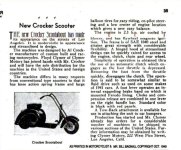
this is what a 1941 Crocker looks like just for reference
 

Attachments

  • 41 scootabout (2).jpg
    41 scootabout (2).jpg
    83.4 KB · Views: 20
Id take a closer look at the AMCA judges, are they the same old names

how is it possible that the AMCA, collectively can accept the fake history ?

the 1930s 'motorcyclist' magazines have all the facts in b/w as it unfolded.
 
Ive been on this for years. I joined this forum because of LEO board that I assumed cops were available....

...one DMV pointed me to Washington and I dont want that. I checked FBI and there are plenty of cases of bent DMV officers.

Ive been on this for years and I still dont know what to call it. its not a chop shop so its not 10801

This has certainly been an interesting conversation, but I'm not sure what the question is? If you suspect illegal activity is going on, or you've been the victim of illegal activity, then I'd suggest contacting your local police department and certainly not discuss details in a public forum. If the intent is simply to discuss the way bikes are restored and the semantics of what is considered "historic" and what isn't, then perhaps this conversation would receive more attention in the vintage sub-forum. I just don't see any specific question related to vehicle code issues (which are the most common questions on the LEO forum).
 
This has certainly been an interesting conversation, but I'm not sure what the question is? If you suspect illegal activity is going on, or you've been the victim of illegal activity, then I'd suggest contacting your local police department and certainly not discuss details in a public forum. If the intent is simply to discuss the way bikes are restored and the semantics of what is considered "historic" and what isn't, then perhaps this conversation would receive more attention in the vintage sub-forum. I just don't see any specific question related to vehicle code issues (which are the most common questions on the LEO forum).

Yeah, good call. I've been pretty lost in this whole thread, except for the advice you gave.
 
Yeah, good call. I've been pretty lost in this whole thread, except for the advice you gave.

:thumbup

here’s a question ... was talking to my Indian/AMCA buddy tonight about this thread and forged Crockers and the stack of fresh engine cases and what would prevent someone from simply stamping a number on them, and without missing a beat he said “oh, that’s a felony.”

is my friend correct? and if so, what sort of prison term would a person who was charged with doing that be looking at?
 
Last edited:
Id take a closer look at the AMCA judges, are they the same old names

how is it possible that the AMCA, collectively can accept the fake history ?

the 1930s 'motorcyclist' magazines have all the facts in b/w as it unfolded.

I’ll ask my friend about judging and a particular bike’s history being faked.

he’s just recently gotten involved with being asked to help judge Indians at the annual AMCA events here in Northern California. my impression is just like anything with a club, serving as a judge is a thankless task no one in the club wants to do ... :laughing:angel

I’m sure judging Crockers is a whole ‘nother ball of wax, but he may have some insight for us. guessing it will be an interesting conversation, anyway. maybe he’s heard about the usual-suspect AMCA Crocker judges, and whether they are corrupt, or what their reputation is ... :dunno

(my main point about some old bikes was that some of them have been shown over a course of years, be it Del Mar, the Quail or at AMCA events, and that’s one way to help authenticate them. iow, a bike shown at Del Mar in the 1990s is less likely to have been forged in the 2000s? idk.)
 
Last edited:
feel free to delete the thread

I never suggested to delete the thread. I am merely trying to better understand your concern. You began by mentioning the DMV several times, but the conversation continued beyond DMV related issues, so I'm not clear what the concern is(?) Perhaps you are just unhappy that someone making reproduction parts and selling them as original and wanting to have an open discussion about that topic... which I understand.
 
:thumbup

here’s a question ... was talking to my Indian/AMCA buddy tonight about this thread and forged Crockers and the stack of fresh engine cases and what would prevent someone from simply stamping a number on them, and without missing a beat he said “oh, that’s a felony.”

is my friend correct? and if so, what sort of prison term would a person who was charged with doing that be looking at?

I'd be curious to know why your friend believes this would be a felony? I don't believe there is anything wrong with making engines and frames. I build my own frames and I have a friend who makes his own engines. I don't believe anyone would care if my friend stamped numbers into his engines. Frames are a bit more complex because they host the full VIN# which has both federal and SAE requirements. But I don't believe engines follow these same guideline. And for all we know, the person making the reproduction Crocker engines may have received the proper permission.:dunno

I do recall a conversation I had many years ago with a CHP vehicle inspection officer about VIN tampering associated with new frames. In the situation we were discussing a well know fabricator was building frames (of his own design), but then grafting steering heads from mass produced frames onto his custom frames so that his frames would then be titled as if coming the larger manufacturer. But I don't think that is the exactly the situation here.

So again, I don't see anything wrong in making your own parts and putting a serial number on them (technically an engine# is NOT a VIN#). Now if the the parts are being described as something which they are not and being sold as such, that could be construed as misrepresentation or possibly even being counterfeit, but I see that as a different scenario than just putting a number on something.

I'll add that this is all just my opinion, so I really am curious why your friend immediately said "felony"?
 
Last edited:
:thumbup

here’s a question ... was talking to my Indian/AMCA buddy tonight about this thread and forged Crockers and the stack of fresh engine cases and what would prevent someone from simply stamping a number on them, and without missing a beat he said “oh, that’s a felony.”

is my friend correct? and if so, what sort of prison term would a person who was charged with doing that be looking at?

Hmmmm, I'm not really sure. I tend to agree with Frame Maker here. I don't necessarily think it would be a crime.

This is different than altering, removing, or destroying a manufacturer serial number. That is a crime, and possession of such item is also a crime. https://leginfo.legislature.ca.gov/faces/codes_displaySection.xhtml?lawCode=PEN&sectionNum=537e. Whether or not it is a felony depends on the value of the property. And pretty much in California nowadays, no one goes to prison over property crimes anymore.
 
Hmmmm, I'm not really sure. I tend to agree with Frame Maker here. I don't necessarily think it would be a crime.

This is different than altering, removing, or destroying a manufacturer serial number. That is a crime, and possession of such item is also a crime. https://leginfo.legislature.ca.gov/faces/codes_displaySection.xhtml?lawCode=PEN&sectionNum=537e. Whether or not it is a felony depends on the value of the property. And pretty much in California nowadays, no one goes to prison over property crimes anymore.

:thumbup

just find all this stuff fascinating ... getting involved in showing old bikes sounds like fun to me.

anyway, don’t think we’re talking about the awesome people who make their own frames and get them properly registered honestly for the street, so my pal wasn’t thinking of what you do, framemaker. :gsxrgrl

this is, I think, responsive to the OP? explains Mr Bojangle’s link, a bit, and supports his take:

California Vehicle Code 10803 VC, buying or possessing vehicles with tampered VINs is an offense related to VIN tampering. Vehicle Code 10803 VC makes it a “wobbler” offense to buy or possess more than one vehicle (or parts from more than one vehicle) with altered VINs for the purpose of selling them.

there may be a better VC section, idk.

will be interesting to discuss the meaning of “altered” here, maybe it wouldn’t apply to our stack of fresh Crocker cases that someone is knowingly putting numbers on with an intent to deceive.

can’t imagine there isn’t case law that clarifies someone simply putting fresh numbers on a fresh part as opposed to sanding one off first. would think in the car world everything under the sun has been seen before?

fun to think about ... :party

(have been told that “wobbler” means it can be charged as either a felony or a misdemeanor. Mr Bojangles references it, above. in my example to my friend I included the fraudulent intent of our stack of new Crocker cases, so he went with felony, I guess, assuming this was the VC section he had in mind.

here’s an extra credit question, is felony altering 16mo/2 years or 3 years the prison term, assuming we still sent people to prison?)
 
Last edited:
Back
Top