• There has been a recent cluster of spammers accessing BARFer accounts and posting spam. To safeguard your account, please consider changing your password. It would be even better to take the additional step of enabling 2 Factor Authentication (2FA) on your BARF account. Read more here.

type of motor oil to use in 1997 Bandit 1200s?

The choice is yours, but choosing a 30w over a 40w 50w is smarter because it will:

1)increase 2 to 3 HP at the rear wheel
2)quicken the throttle response coming out of the corners...
3)decrease over all operating temps...
4)increase the oil flow at the critical bearings...

Any one of 30w 100% synthetic motorcycle specific or car oils will meet
and exceed both your riding and mileage expectations...

Quote 540Rat
SECTION 2 – MOTOR OIL VISCOSITY SELECTION

THE BENEFITS OF USING THINNER OIL:

• Thinner oil flows quicker at cold start-up to begin lubricating
critical engine components much more quickly than thicker oil can.
Most engine wear takes place during cold start-up before oil flow can
reach all the components. So, quicker flowing thinner oil will help
reduce start-up engine wear, which is actually reducing wear overall.

• The more free flowing thinner oil at cold start-up, is also much
less likely to cause the oil filter bypass to open up, compared to
thicker oil. Of course if the bypass opened up, that would allow
unfiltered oil to be pumped through the engine. The colder the ambient
temperature, and the more rpm used when the engine is cold, the more
important this becomes.

• Thinner oil also flows more at normal operating temperatures. And
oil FLOW is lubrication, but oil pressure is NOT lubrication. Oil
pressure is only a measurement of resistance to flow. Running thicker
oil just to up the oil pressure is the wrong thing to do, because that
only reduces oil flow/lubrication. Oil pressure in and of itself, is
NOT what we are after.

• The more free flowing thinner oil will also drain back to the oil
pan quicker than thicker oil. So, thinner oil can help maintain a
higher oil level in the oil pan during operation, which keeps the oil
pump pickup from possibly sucking air during braking and cornering.

• The old rule of thumb that we should have at least 10 psi for every
1,000 rpm is perfectly fine. Running thicker oil to achieve more
pressure than that, will simply reduce oil flow for no good reason. It
is best to run the thinnest oil we can, that will still maintain at
least the rule of thumb oil pressure. And one of the benefits of
running a high volume oil pump, is that it will allow us to enjoy all
the benefits of running thinner oil, while still maintaining
sufficient oil pressure. A high volume oil pump/thinner oil combo is
preferred over running a standard volume oil pump/thicker oil combo.
Because oil “flow” is our goal for ideal oiling, NOT simply high oil
pressure.

• Oil flow is what carries heat away from internal engine components.
Those engine components are DIRECTLY oil cooled, but only INdirectly
water cooled. And better flowing thinner oil will keep critical engine
components cooler because it carries heat away faster. If you run
thicker oil than needed, you will drive up engine component temps. For
example: Plain bearings, such as rod and main bearings are lubricated
by oil flow, not by oil pressure. Oil pressure is NOT what keeps these
parts separated. Oil pressure serves only to supply the oil to this
interface. The parts are kept apart by the incompressible hydrodynamic
liquid oil wedge that is formed as the liquid oil is pulled in between
the spinning parts. As long as sufficient oil is supplied, no wear can
occur. In addition to this, the flow of oil through the bearings is
what cools them.

Quote Gmtech94

When I raced we were sponsored by an oil company and helped with the
research of their product .The thought at the time was to run 20w50
race oil to provide for the best lubrication under racing conditions
hence no oil related failures . After many races and a lot of real
data research the conclusion was in this case to run a 10w30 oil as it
provided better lubrication and less engine wear over a long period of
time ,remember endurance racing in 24 and 30 hour races . Although we
never had an engine failure due to oil properties we did have a lot of
feedback on engine wear as well as transmission and clutch wear . I
have to say we did abuse these bikes on occasion with spinning the
back wheel to turn the bike as well as the occasional fall .The
ignition was a weak link but I could change out the pulsers in about
17 seconds once the bike was in the pits . In conclusion 10w30 ran
cooler and did not break down as much as the thicker oils did.

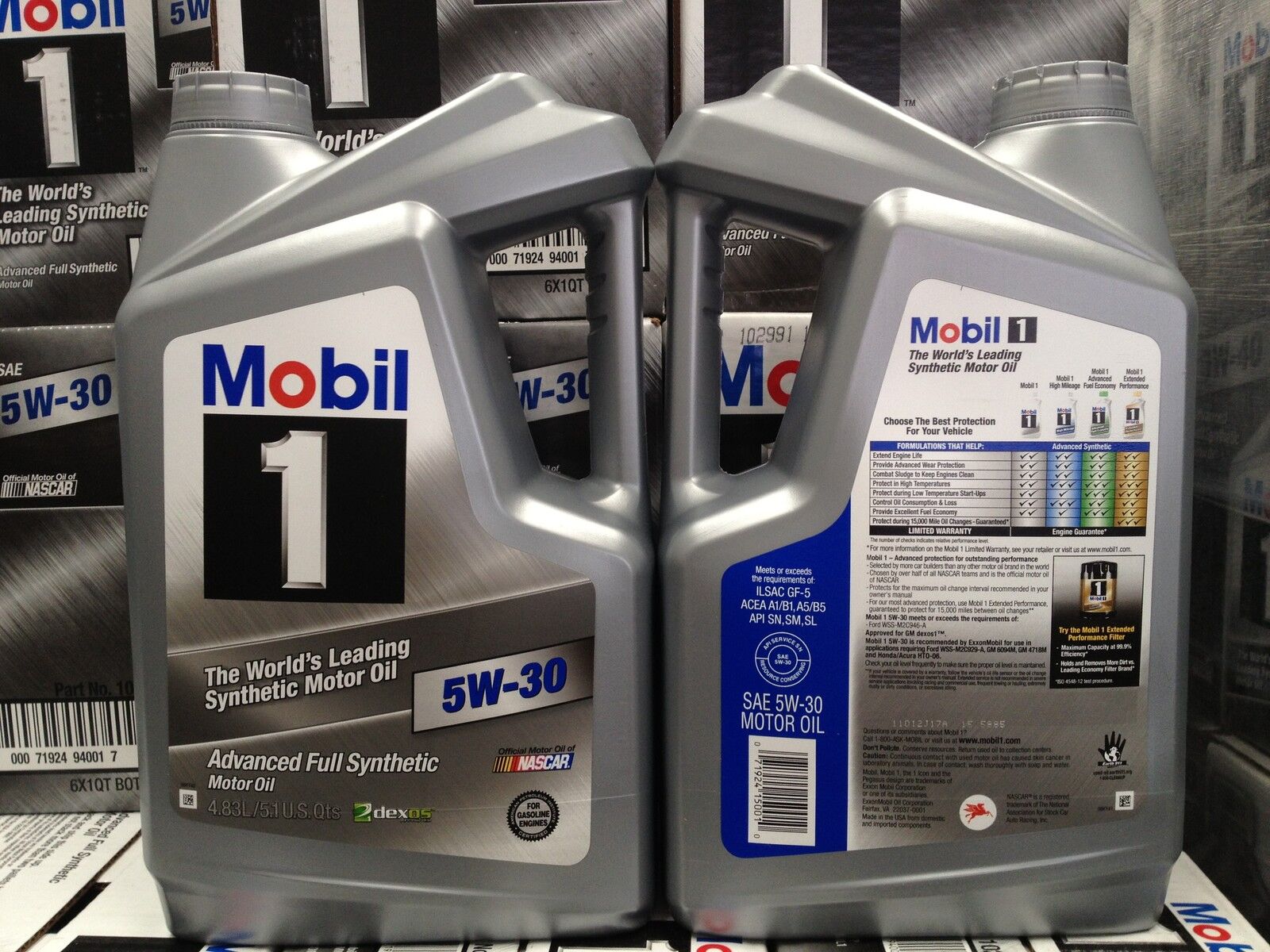
Depending on your bank account I recommend either $5.40 a quart Mobil 1 5w30 API SN
because it was ranked #10 out of 156 oils tested for wear protection by 540Rat... or
ranked #4 5W30 Motul 300V Ester Core 4T synthetic Motorcycle specific about $14.25 per bottle.

https://540ratblog.wordpress.com/
$(KGrHqFHJFQFH+3bLSKwBSF(pTTTDg~~60_57.JPG


0000-Motul-300V-Ester-Synthetic-Oil---.jpg
 
Last edited:
C. Nobody in this thread who recommended synthetic for THIS particular bike has ever owned one. :laughing I ran synth after upgrading the springs. Why did I upgrade them? Because the clutch slipped like a bastard with the stock springs.

How many miles were on the clutch in question???
 
How many miles were on the clutch in question???

About 300.

It was a common problem with the B12, and written about and discussed on the forums at length, common enough that Barnett made up diaphragm springs to fix it. :thumbup

I pretty much agree with your post on Mobil 1 and the weights, though in super hot weather I would still go with 10-40, and with oil cooled bikes as well.
Mobil one is a super great oil. And I ran it in my Bandit. With stronger clutch springs. :laughing
 
About 300.

It was a common problem with the B12, and written about and discussed on the forums at length, common enough that Barnett made up diaphragm springs to fix it. :thumbup

How common??? you mean every B12 owner that ran synthetics experienced clutch slip???
 
How common??? you mean every B12 owner that ran synthetics experienced clutch slip???

No, I am sure they didn't. Every B12 owner who rode the bike hard had problems. I don't care if you believe me, don't believe me, or are sure that I am full of shit!!!
 
+1

Short story short, any multigrade motor oil except for the Energy Conserving flavor and change it every 3k miles.


You're welcome to warn against it but Energy Conserving or Resource
Conserving are not additives... its an API test that this "oil may
result is an overall saving of fuel in the vehicle fleet as a
whole"... there is nothing new in the oil to defeat a wet clutch...
what is confusing the issue is the fact that all motorcycle wet
clutches will reach a point in their life and start to slip EC oil or
non EC oil... have you noticed that no one complains about clutch slip
when the bike is new??? its around the 27K to 57K range as normal
containments build up to point you may find the clutch begins to loose
its grip... this is usually discovered by the owner during WFO (Wide
Fooking Open)throttle like during a quick overtake or at a track day...
in error one can blame the EC oil but its really the contaminants on
the clutch plates...

So the belief that we should stay away from Energy Conserving oil is
on shaky ground... fact is I've been using 5w/30 Energy Conserving
Mobil 1 since 98 in Mr.RC45 with no clutch slipping due to oil being
certified freer flowing than non EC oil and it's a homologated racer with a tall
first gear good for 90mph that's known to incinerate clutch plates...

Quote Rider A
"Yamaha says don't use energy Conserving II. This implies there should
be no problems with regular Energy Conserving or they would have
stated not to use that as well, right? Has anyone actually used Energy
Conserving? If so, did clutch slip or not?"

Quote Rider B
"I ran with EC oil (not EC II) for part of one change period before I
found out that premature clutch wear due to clutch slippage was a
risk. I never experienced any slippage that I could tell, but switched
to non-EC oil once I knew about it."

Quote Rider A
"Well, looks like I put in regular Castrol 10W30 for cars at the 600
mile mark last year. The bottle has the EC mark on it. Just found the
bottles behind my hibernating vehicles. I can add that I didn't even
notice. My clutch was not slipping over the past 2000 miles."
 
No, I am sure they didn't. Every B12 owner who rode the bike hard had problems.

I'm sure they didn't either...

1) What is your definition of "hard" riding versus soft riding???

2)What do believe is the technical difference between straight mineral oil and synthetics that cause them problems???
 
I'm a bit confused about your statement. As in text you seem to be suggesting 10w-30. Yet the images you included are of 5w-30 oil.


The choice is yours, but choosing a 30w over a 40w 50w is smarter because it will:

1)increase 2 to 3 HP at the rear wheel
2)quicken the throttle response coming out of the corners...
3)decrease over all operating temps...
4)increase the oil flow at the critical bearings...

Any one of 30w 100% synthetic motorcycle specific or car oils will meet
and exceed both your riding and mileage expectations...

Quote 540Rat
SECTION 2 – MOTOR OIL VISCOSITY SELECTION

THE BENEFITS OF USING THINNER OIL:

• Thinner oil flows quicker at cold start-up to begin lubricating
critical engine components much more quickly than thicker oil can.
Most engine wear takes place during cold start-up before oil flow can
reach all the components. So, quicker flowing thinner oil will help
reduce start-up engine wear, which is actually reducing wear overall.

• The more free flowing thinner oil at cold start-up, is also much
less likely to cause the oil filter bypass to open up, compared to
thicker oil. Of course if the bypass opened up, that would allow
unfiltered oil to be pumped through the engine. The colder the ambient
temperature, and the more rpm used when the engine is cold, the more
important this becomes.

• Thinner oil also flows more at normal operating temperatures. And
oil FLOW is lubrication, but oil pressure is NOT lubrication. Oil
pressure is only a measurement of resistance to flow. Running thicker
oil just to up the oil pressure is the wrong thing to do, because that
only reduces oil flow/lubrication. Oil pressure in and of itself, is
NOT what we are after.

• The more free flowing thinner oil will also drain back to the oil
pan quicker than thicker oil. So, thinner oil can help maintain a
higher oil level in the oil pan during operation, which keeps the oil
pump pickup from possibly sucking air during braking and cornering.

• The old rule of thumb that we should have at least 10 psi for every
1,000 rpm is perfectly fine. Running thicker oil to achieve more
pressure than that, will simply reduce oil flow for no good reason. It
is best to run the thinnest oil we can, that will still maintain at
least the rule of thumb oil pressure. And one of the benefits of
running a high volume oil pump, is that it will allow us to enjoy all
the benefits of running thinner oil, while still maintaining
sufficient oil pressure. A high volume oil pump/thinner oil combo is
preferred over running a standard volume oil pump/thicker oil combo.
Because oil “flow” is our goal for ideal oiling, NOT simply high oil
pressure.

• Oil flow is what carries heat away from internal engine components.
Those engine components are DIRECTLY oil cooled, but only INdirectly
water cooled. And better flowing thinner oil will keep critical engine
components cooler because it carries heat away faster. If you run
thicker oil than needed, you will drive up engine component temps. For
example: Plain bearings, such as rod and main bearings are lubricated
by oil flow, not by oil pressure. Oil pressure is NOT what keeps these
parts separated. Oil pressure serves only to supply the oil to this
interface. The parts are kept apart by the incompressible hydrodynamic
liquid oil wedge that is formed as the liquid oil is pulled in between
the spinning parts. As long as sufficient oil is supplied, no wear can
occur. In addition to this, the flow of oil through the bearings is
what cools them.

Quote Gmtech94

When I raced we were sponsored by an oil company and helped with the
research of their product .The thought at the time was to run 20w50
race oil to provide for the best lubrication under racing conditions
hence no oil related failures . After many races and a lot of real
data research the conclusion was in this case to run a 10w30 oil as it
provided better lubrication and less engine wear over a long period of
time ,remember endurance racing in 24 and 30 hour races . Although we
never had an engine failure due to oil properties we did have a lot of
feedback on engine wear as well as transmission and clutch wear . I
have to say we did abuse these bikes on occasion with spinning the
back wheel to turn the bike as well as the occasional fall .The
ignition was a weak link but I could change out the pulsers in about
17 seconds once the bike was in the pits . In conclusion 10w30 ran
cooler and did not break down as much as the thicker oils did.

Depending on your bank account I recommend either $5.40 a quart Mobil 1 5w30 API SN
because it was ranked #10 out of 156 oils tested for wear protection by 540Rat... or
ranked #4 5W30 Motul 300V Ester Core 4T synthetic Motorcycle specific about $14.25 per bottle.

https://540ratblog.wordpress.com/

$(KGrHqFHJFQFH+3bLSKwBSF(pTTTDg~~60_57.JPG


0000-Motul-300V-Ester-Synthetic-Oil---.jpg
 
I'm sure they didn't either...

1) What is your definition of "hard" riding versus soft riding???

2)What do believe is the technical difference between straight mineral oil and synthetics that cause them problems???

I don't believe anything. I responded with a known, real world problem with a specific bike model due to a weak clutch. One that was discussed at length in B12 forums.
 
I'm a bit confused about your statement. As in text you seem to be suggesting 10w-30. Yet the images you included are of 5w-30 oil.

And bada bing!

We have side tracked confused the OP with a complicated motor oil discussion when it's really not that complicated. :rolleyes
 
Last edited:
And bada bing!

We have side tracked confused the OP with a complicated motor oil discussion when it's really not that complicated. :rolleyes

Absolutely what I'm thinking now. Especially with advice running from absolutely only use full synthetic 10w-30, to only use non synthetic regular oil 10w-40 or cause damage. Buy I appreciate the sharing of opinions. But I appreciate the sharing of opinions.

I was un the store looking at oils when more posts here came in, and i tuly have no idea what to do now. So have not purchased any oil.
 
Last edited:
Try some Motul or Mobil-1 full synthetic.

You can always either change back to dino oil if you get clutch slippage, or it will work wonderfully w/a likely "slight" increase in HP, & increase in MPG.

If it don't work, just go back to what you had before. :afm199
 
OP: The instances of synthetics causing clutch slippage are way, way, way over blown. Don't worry about it. Seriously. Do you think all the race teams, factory and privateer, use regular oil? No way. They all use full synthetics because of their superior performance. And many, many bikes come from the factory with full synthetics.

I know oil threads are often a rat hole, but don't get sucked down. Those who decry the use of synthetics are, for the most part, wrong. For those very few instances where a better lubricant causes problems, the defect should be fixed rather than trying to "cure" it by not using a superior product. Like with the 1200 and aftermarket parts to fix the clutch.

And in the case of your bike, where the engine is air/oil cooled, I would use nothing but full synthetic. Air/oil cooled engines are even harder on oil than water cooled engines and for that reason you want the best oil you can in your engine.
 
Last edited:
OP: The instances of synthetics causing clutch slippage are way, way, way over blown. Don't worry about it. Seriously. Do you think all the race teams, factory and privateer, use regular oil? No way. They all use full synthetics because of their superior performance. And many, many bikes come from the factory with full synthetics.

I know oil threads are often a rat hole, but don't get sucked down. Those who decry the use of synthetics are, for the most part, wrong. For those very few instances where a better lubricant causes problems, the defect should be fixed rather than trying to "cure" it by not using a superior product. Like with the 1200 and aftermarket parts to fix the clutch.

And in the case of your bike, where the engine is air/oil cooled, I would use nothing but full synthetic. Air/oil cooled engines are even harder on oil than water cooled engines and for that reason you want the best oil you can in your engine.

Yep. I've used Mobil one for decades. In fact the ONLY time it has been a problem was with, gasp, the B12 which is what this thread is about. The B12 stock clutch is a total POS.

And that Is why I suggest not using Mobil one in the B12 until you change the clutch springs. This is something that has been discussed in B12 forums for literally twenty years.
 
Absolutely what I'm thinking now. Especially with advice running from absolutely only use full synthetic 10w-30, to only use non synthetic regular oil 10w-40 or cause damage. Buy I appreciate the sharing of opinions. But I appreciate the sharing of opinions.

I was un the store looking at oils when more posts here came in, and i tuly have no idea what to do now. So have not purchased any oil.

You won't cause damage with non synth, you will get better engine life with synth. The only downside of synth ( and I don't care what the BARF "experts" say) is that on THIS particular bike ( I use mobil one synth in ALL my vehicles) you MAY have a problem if you ride the bike hard, with clutch slippage. The clutch on the B12 is a POS and needs the springs replaced.

Use 10-40 in any case, it's what the manufacturer recommends.
 
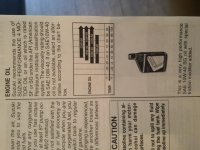
So I checked the little manual that came with the bandit. It does not clarify, oddly, whether synthetic or regular oil should be used. Just says 10w-40.
 

Attachments

  • tmp_16800-20170615_1254111068469193.jpg
    tmp_16800-20170615_1254111068469193.jpg
    78.2 KB · Views: 10
Suzuki will tell you to use their Suzuki Performance Oil. Yamaha will tell you to use their Yamalube. Listen to AFM199
 
So I checked the little manual that came with the bandit. It does not clarify, oddly, whether synthetic or regular oil should be used. Just says 10w-40.

Bingo! You have your answer again. 10w-40. Go get some.
 
Maybe I will try running synthetic in the buell again, it beats the shit out of oil so I change it like every 1500 miles using whatever 15w40 diesel is on sale. Fucking thing doesnt smoke or leak but oil goes somewhere.
 
Back
Top