• There has been a recent cluster of spammers accessing BARFer accounts and posting spam. To safeguard your account, please consider changing your password. It would be even better to take the additional step of enabling 2 Factor Authentication (2FA) on your BARF account. Read more here.

Proper Body positioning when cornering

It comes back to some essentials.

  • The idea of where your nose is over the bars is a good indicator.
  • Are your arms stiff? Clip-on style modern sportbike bars will have the recreational rider stiffen his arms unconsciously. Relax the arms and use your legs to grip the tank, and like what was mentioned before, use the pegs. Use them to see what you get and take mental notes.
  • Bend your elbows, this helps learning to relax the arms. The relax exercise is perhaps the most important thing.
  • Trusting them tires on a lean is important, but knowing also what the bike feels like when braking when you shouldn't be, is a trainable thing. Builds confidence if you try it at slow speeds, mid-turn, and see how the bike behaves.
  • Smooth throttle, steady into curves and apply gas evenly after apex.
  • Enter your apexes late. You can see the curve exit better to set yourself up for the next maneuver.
  • You mentioned you find yourself braking more. Are you also accelerating more? Give yourself a few laps through the same set of curves and stay in second or third, at a pace just above the marked advisory speed. Frinstance, for 25, do 30, for 30, do 35, etc but note, for warnings of 20 and below heed them while doing this practice. Just go through the curves without touching the brakes. This is a great skill builder

HTH
 
Bikes and tires were very different long ago, it's not helpful to compare old-school riding styles to modern riding styles with modern bikes and tires. 500GP stars would probably get destroyed by modern competition, even if they rode identical bikes.
I have little knowledge of such bikes, but I imagine as the machinery changed, so did methods to effectively pilot them.

And stickin to my guns, just because a few people can effectively win using unorthodox styles, doesn't mean we should condone letting new riders think they will be the next motogp champ riding around all crossed up. Get the basics of BP down first then tweak from there to suit your riding style
 
I have little knowledge of such bikes, but I imagine as the machinery changed, so did methods to effectively pilot them.

The other possibility is that techniques change and improve over the course of 20 years. What is common now might have been unknown back then. Not only have the bikes improved, but the riders have improved as well.

"It's a poor teacher that isn't surpassed by his students."

A master spends a lot of time improving his craft. What took years to fine tune doesn't have to take years to pass on, leaving another generation to push riding techniques even further. Compare "A Twist of the Wrist" to "The Soft Science of Road Racing" for a wonderful example.
 
Guys look at my second to last post. I highlighted factors that might have contributed to the old school styles, I'm not unaware of the situations are different now. I ride the evolved modern form of riding. I' m more or less playing devils advocate.

Mike The Bike rode more like the modern style even back then! Well he is the man, so no surprise there.
 
And stickin to my guns, just because a few people can effectively win using unorthodox styles, doesn't mean we should condone letting new riders think they will be the next motogp champ riding around all crossed up.

When we say things like "condone letting new riders...," it suggests we've assumed a position of authority. Sometimes people are receptive to that and sometimes they're not.

I prefer taking an approach where I describe a technique and indicate the benefits to it. This allows people to think through the trade-offs associated with changing something about their riding. When it comes to riding position, when we ask someone to change what they're doing, we're asking them to stop doing what they find familiar or comfortable and to begin doing something new and unfamiliar. They may come to find the new position advantageous, but initially, it is unfamiliar and gives them something additional to think about each time they set up for a corner. There ought to be something in it for them in return.

In the case of the more modern, "not crossed up" body position, there are three main areas of benefit I describe to people. I'll provide them later, but I'm curious what pros and cons others have noticed with respect to body position.
 
Humm, Just goes to show how complex a seemingly simple and straightforward question really is.

Body position has to vary, the corners vary, the place the corners are at vary, and the bikes vary, And the bikers skill level is varying as time goes by. Kinda a butt load of variables :x
 
When we say things like "condone letting new riders...," it suggests we've assumed a position of authority. Sometimes people are receptive to that and sometimes they're not.

Valid point, I have no authority what so ever, so everything I say should be taken with a few grains of salt

I prefer taking an approach where I describe a technique and indicate the benefits to it. This allows people to think through the trade-offs associated with changing something about their riding. When it comes to riding position, when we ask someone to change what they're doing, we're asking them to stop doing what they find familiar or comfortable and to begin doing something new and unfamiliar. They may come to find the new position advantageous, but initially, it is unfamiliar and gives them something additional to think about each time they set up for a corner. There ought to be something in it for them in return.

Agreed again, but isn't the paydirt great when you tell them one small change that could help a lot, they go employ it, and come back beaming about its advantages?

In the case of the more modern, "not crossed up" body position, there are three main areas of benefit I describe to people. I'll provide them later, but I'm curious what pros and cons others have noticed with respect to body position.

I got to the track early and started on BP then thanks to the folks at Keigwins, so I noticed immediately the pros of the vs the cons, even as a completely slow and daft novice, minor changes in how I was on the bike made major changes in not only how it handled, but how confident I was in making turns at a faster and faster pace.

Now I'm to the point, where I can tell if I'm making a mistake or not, the bike will fight me and not turn as well, once I correct the mistake, the change in handling is once again realized.
 
Now I'm to the point, where I can tell if I'm making a mistake or not, the bike will fight me and not turn as well, once I correct the mistake, the change in handling is once again realized.


towards the end of the day when i my body is physically tired and i can't hold my self on the bike without apply a good amount of weight to my handle bar, my lines get thrown off, every bump is exagerated, and the whole bike is just unsettling.

I feel when some one is asking for help give them one mechanism to work with. "Try this one thing, then if you like it do this next" This will allow them to see the difference.

If you give some on a list of things to change at once, they will be concentrating too hard trying to remember everything, and also they wont learn the "whys" of each one.
 
i ride crossed up. hey if you're fast riding crossed up and don't crash wouldn't that be riding properly?
 
i ride crossed up. hey if you're fast riding crossed up and don't crash wouldn't that be riding properly?


riding position is more than just the location of you head and ass in relation to your body. but you already knew that...:twofinger
 
towards the end of the day when i my body is physically tired and i can't hold my self on the bike without apply a good amount of weight to my handle bar, my lines get thrown off, every bump is exagerated, and the whole bike is just unsettling.

Yep, when im not hanging off enough and/or stiff on the bars, everything becomes harder and I make myself and the biker work much harder than it needs too.

I feel when some one is asking for help give them one mechanism to work with. "Try this one thing, then if you like it do this next" This will allow them to see the difference.

baby steps :thumbup


riding position is more than just the location of you head and ass in relation to your body. but you already knew that...:twofinger

Yah, I define being crossed up as being on the wrong side of the center line of the bike. Others define it as your spine being mis aligned with the center line of the bike, I treat those 2 things separately.

Robert Haas (of trackcrafters) had a simple way to play with this. Assume the gas cap is a beam of light. If you are going left, you want your head to be to the left of that beam, going right, on the right side of it.

Regardless of what your ass is doing, just moving your head (which forces your upper body to follow) onto the correct side of the center line while corning made an immediate impact in how stable the bike felt (my personal experience). Even on the street at low speeds, I could tell the difference

Then you expand on it at the track, getting your head lower and farther over, dropping the elbow/kissing the mirror, and then sliding your ass over to match how far your upper body is off the bike. I can see this exact progression in my track pictures :thumbup
 
Robert Haas (of trackcrafters) had a simple way to play with this. Assume the gas cap is a beam of light. If you are going left, you want your head to be to the left of that beam, going right, on the right side of it.

Regardless of what your ass is doing, just moving your head (which forces your upper body to follow) onto the correct side of the center line while corning made an immediate impact in how stable the bike felt (my personal experience). Even on the street at low speeds, I could tell the difference

Then you expand on it at the track, getting your head lower and farther over, dropping the elbow/kissing the mirror, and then sliding your ass over to match how far your upper body is off the bike. I can see this exact progression in my track pictures :thumbup

You're doing a good job of describing this body position. What advantages have you found with it, as opposed to riding with your hips farther off than your shoulders?
 
Regardless of what your ass is doing, just moving your head (which forces your upper body to follow) onto the correct side of the center line while corning made an immediate impact in how stable the bike felt (my personal experience). Even on the street at low speeds, I could tell the difference

This one thing makes a huge difference even on the GL1800.

You would not expect it on a 900Lb bike, but the bike feels squirely when heeled well over, if I don't have my head leaned to the inside and a relaxed grip on the bars.

Every time it feels squirely now, I either have my head on the centerline or am tensed up.
 
You're doing a good job of describing this body position. What advantages have you found with it, as opposed to riding with your hips farther off than your shoulders?

Hmm, I can't really comment. I actually was the opposite in my progression. When I first started, I was getting my upper body over more so than my ass. Since I was getting my upper body over, while my ass was still locked in the seat, I faced other issues. Such as not being able to swing out my knee correctly to use as a lean angle indicator, and not locking onto the tank as well. So it fatigued both my upper and lower body more than it should. Now that im finally starting to move my ass more and line up my spine with the center line, I find I can tend to keep less pressure on the bars. This helps with turning the bike under hard braking (the bit really doesnt like to turn when you are stiff :teeth) and in places like T2 at thill, I can now basically take my hand off the inside clip on. So when I tense up and am basically hanging onto the clip on, I know I'm doing something wrong.

It also helps a ton when exiting corners, you can get on the gas earlier and harder if you are hanging off
 
Hmm, I can't really comment. I actually was the opposite in my progression. When I first started, I was getting my upper body over more so than my ass. Since I was getting my upper body over, while my ass was still locked in the seat, I faced other issues. Such as not being able to swing out my knee correctly to use as a lean angle indicator, and not locking onto the tank as well. So it fatigued both my upper and lower body more than it should. Now that im finally starting to move my ass more and line up my spine with the center line, I find I can tend to keep less pressure on the bars. This helps with turning the bike under hard braking (the bit really doesnt like to turn when you are stiff :teeth) and in places like T2 at thill, I can now basically take my hand off the inside clip on. So when I tense up and am basically hanging onto the clip on, I know I'm doing something wrong.
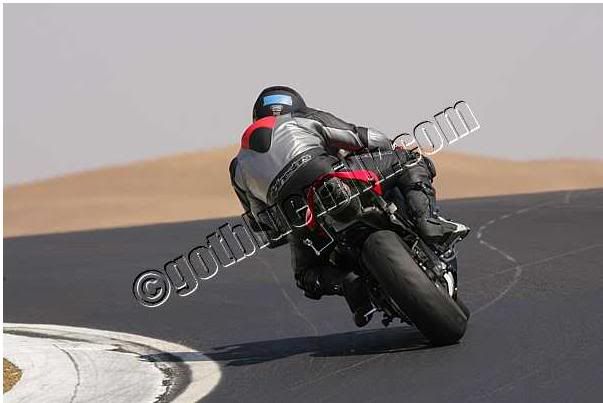
It also helps a ton when exiting corners, you can get on the gas earlier and harder if you are hanging off

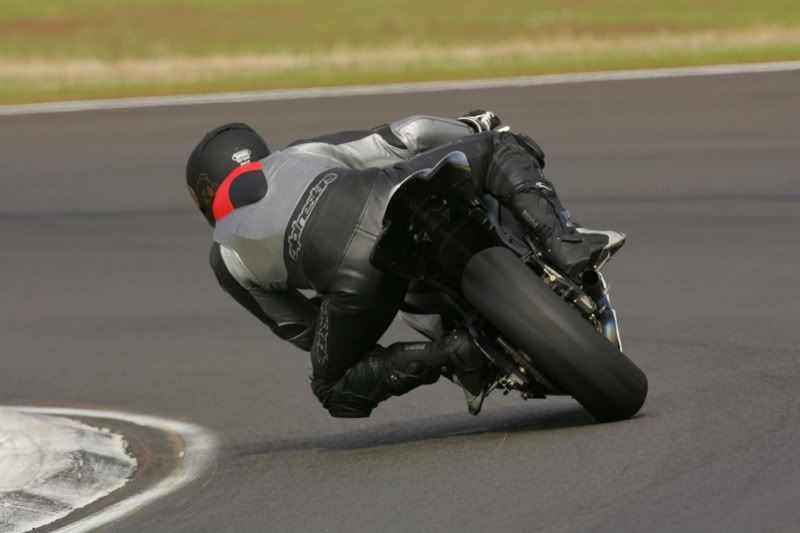
The two styles of hanging off I'm contrasting are:

  • Hanging off crossed up, with the ass farther off than the shoulders and
  • Hanging off so the spine is parallel with the bike, if viewed from above.

I favor B above. The three main areas of advantage are:

1) It's easier to lock onto the bike. The gas tank is a primary anchor point for hanging off. If your hips are farther off the bike than your head and shoulders, your hips rotate a few degrees. The rotation pries your knee away from the side of the tank and leaves only your inner thigh in contact with the tank towards the rear. Instead of pressing straight into the side of the tank, you're hanging on primarily via friction between your leg and the rear surface of the tank.

By contrast, when your hips are square to the tank, your knee can make solid contact with the outside of the tank and press straight into it. You're not prone to slipping on the tank and feel quite a bit more secure. When riders feel like they're not locked onto the bike, they usually get tight on the bars.

2) A main goal of hanging off is to move weight to the inside of the turn. If you hang your upper body off as much as your hips, you move more weight off the bike.

3) If you hang off with your spine parallel to the bike, your body is closer to facing into the turn than if you're crossed up. When crossing up, the rider's body is facing to the outside of the turn. He must turn his head that much farther to look into the turn. When the rider is parallel to the bike, it's easier for him to look farther into the turn.
 
The two styles of hanging off I'm contrasting are:

  • Hanging off crossed up, with the ass farther off than the shoulders and
  • Hanging off so the spine is parallel with the bike, if viewed from above.

I favor B above. The three main areas of advantage are:

Yeah, I imagine these are the 2 most commonly seen, I just did it the other way around.

First track day. Hanging on for dear life and crossed up :laughing
b41.jpg


Next weekend out at thill. Ass still mainly in the seat. But upper body well off the bike Missin the apex too
MF1A1394.jpg


3rd weekend out at thill. Ass starting to meet my shoulders. Getting a bit closer to the apex too :p
n1200374_42667631_5626.jpg


T2 same day. Spine mostly lined up bike and well off the bike.
n1200374_42667637_443.jpg


And I agree fully with you how having your spine lined up and ass square to the bike really helps out in reducing fatigue and locking into the bike. First 2 weekends I was tired as all hell literally "hanging off" the bike and not properly anchoring my lower body. 3rd weekend, while going at a much faster pace, I was much more comfortable and relaxed out there, while being less tired at the end of sessions. I don't have many issues looking well through turns either without having to bit a crick in my neck :ride
 
Nice form

n1200374_42667631_5626.jpg


the guy's infront of you:twofinger
 
he has better foot position, I'll give him that. :thumbup

I think his lower body positioning is a bit extreme though
 
he looks like Tony Elias
 

Attachments

  • sg33fn.jpg
    sg33fn.jpg
    98.1 KB · Views: 198
Last edited:
Read TZrider's explanation :cool

having your entire ass off the seat lends to rotating your hips. Ideally (of course not a solid rule), you want your hips and shoulder to be square with the bike. I've ridden behind you before so I know why you favor his body position over mine lol
 
Back
Top