• There has been a recent cluster of spammers accessing BARFer accounts and posting spam. To safeguard your account, please consider changing your password. It would be even better to take the additional step of enabling 2 Factor Authentication (2FA) on your BARF account. Read more here.

This is why ABS haters are wrong

^^^^^^^ The last great motorcyclist.:afm199

:laughing Might be a dying breed...But there are others coming along.

Josh Hayes said "Turn it off, turn all of it off" and proceeded to win the championship.

Marc Marquez is beating the best ... He trains on dirt as well as pavement.
He knows the value of the skills of making saves.
Knows how he got them and how to keep the sharp edge.

And Ernie Knows :) :afm199
 
I can barely ride my ruckus now, thanks to all of the rider aids on my other bikes making me soft. :|
 
For most of my riding, I would be open to ABS, fuel injection, etc. If I were doing a long (i.e. 3000+ mile) trip out in the boonies, I would actually prefer an air cooled, carbureted, old school bike (i.e. DR650, etc).

I'll take the FI water cooled bike every time. I've ridden both carbureted and FI bikes into the boonies, albeit maybe 2/3 that distance and without a doubt the FI bike was easier to ride, more reliable, less maintenance and more powerful.
The water cooled engine comes with FI because of the power and heat generated. Can't get away from that with FI.

It's a proven fact that riders with ABS suffer from testicle shrinkage and impotence.

So that's whats wrong. :facepalm


And to keep this on the ABS topic. Just give me a switch to turn it on and off where it stays off until I want it back and I'm good.
 
Last edited:
For the most part, I agree with you, boney. The reason I would choose a tractor for really remote trips is the fact that I have broken down in the past, and I have punctured radiators in the past, etc. There isn't much that is going to break on a DR650. There are ALL KINDS of things that can go wrong with my 690. I own the 690 because it is A LOT more fun to ride and because I am rarely more than 100 miles from some sort of town/city/village.
 
What chaps my ass, is the opinions of never learned, have no intention of learning, and counting on this technology to do the deed. :laughing

So do you chap your own ass because you enjoy it or some other, more metaphysical reason? :laughing
 
For the most part, I agree with you, boney. The reason I would choose a tractor for really remote trips is the fact that I have broken down in the past, and I have punctured radiators in the past, etc. There isn't much that is going to break on a DR650. There are ALL KINDS of things that can go wrong with my 690. I own the 690 because it is A LOT more fun to ride and because I am rarely more than 100 miles from some sort of town/city/village.


If You need mechanical help, in the boonies...You want to be riding something the boonie folk ride....Thats what the boonie wrenches work on. :cool
 
If You need mechanical help, in the boonies...You want to be riding something the boonie folk ride....Thats what the boonie wrenches work on. :cool

I realize not everything can be planned for, but nobody should ever ride a bike into the boonies that they're not already 100% sure will make it back. That includes having spare parts for known issues after fitting new parts (and testing them) to the same known issues before leaving.
 
If You need mechanical help, in the boonies...You want to be riding something the boonie folk ride....Thats what the boonie wrenches work on. :cool

Yuppers. That's why I like low tech bikes for those trips.

I realize not everything can be planned for, but nobody should ever ride a bike into the boonies that they're not already 100% sure will make it back. That includes having spare parts for known issues after fitting new parts (and testing them) to the same known issues before leaving.

I agree with you in theory, but it is impossible to carry that many spare parts on a multi thousand mile, multi country ride. When I returned from Brazil, my bike had a few parts on it that were meant for other bikes, and a couple that were actually car parts. Sometimes, it's all about fixing things with the materials available. :laughing
 
Yuppers. That's why I like low tech bikes for those trips.

While I understand the desire to have something that is relatively easy to work on when out in the middle of no where, high tech is not synonymous with unreliability. Having both high tech and low tech bikes occupying spots in my garage, I trust the high tech bike for long rides, even if it is an earlier model.

As always, your mileage may vary...
 
While I understand the desire to have something that is relatively easy to work on when out in the middle of no where, high tech is not synonymous with unreliability. Having both high tech and low tech bikes occupying spots in my garage, I trust the high tech bike for long rides, even if it is an earlier model.

As always, your mileage may vary...
I COMPLETELY agree with you that higher tech does not equal less reliable. In fact, I would argue that most higher tech bikes are probably MORE reliable than the old bikes. That said, if something goes wrong on the high tech bike, there is a much smaller chance that I will be able to fix it in the field or even in a small town. For trail riding and semi local trips it is a non-issue. If I'm going to be thousands of miles from home, I would prefer the low tech tractor bike.
 
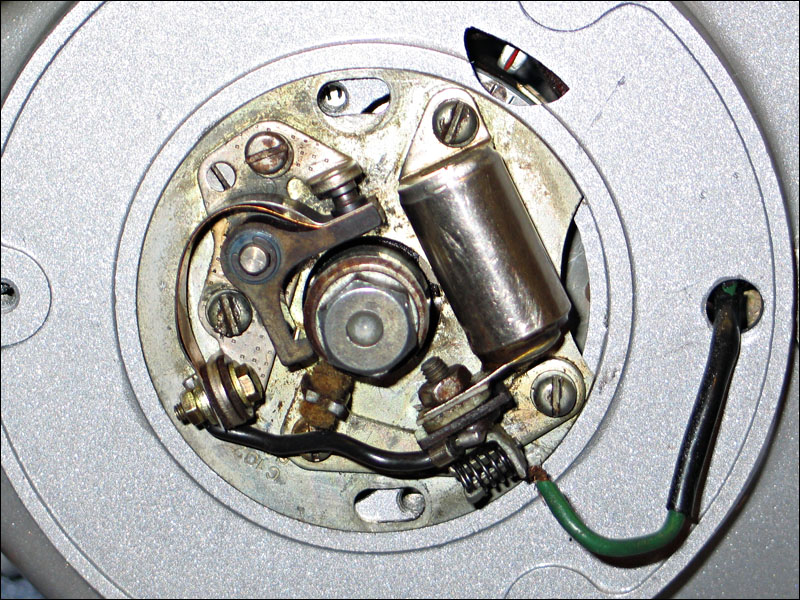
I don't miss these at all:
ca95_points.jpg


For some of us working on our bikes and fixing things come naturally. We are the minority most riders just want to ride. They could care less how the bike works as long as it works.
 
I don't miss these at all:

For some of us working on our bikes and fixing things come naturally. We are the minority most riders just want to ride. They could care less how the bike works as long as it works.

Fucking points :mad
 
New and complex vs. old and simple is a tradeoff between probability of a breakdown and severity of a breakdown. A new high-tech bike is less likely to break down, but when it does break down the severity is high, because you won't be able to get it going again without help. An old simple bike is more likely to break down, but when it does break down the severity is low, because you can likely fix it with a screwdriver and an adjustable wrench.

In a situation where you're riding close to civilization, a new bike makes more sense, because in the rare event of breaking down you'll be able to get help. But if you're riding somewhere remote and dangerous, where you can't expect help and getting stuck can mean death (maybe like crossing the Sahara desert or something), a simple bike that's easy to fix is better. You're more likely to break down, but you can fix it so overall you're less likely to die.
 
I would disagree that the low tech is less reliable. I think that it's more labor intensive to operate reliably, but just as reliable if you are willing to perform the maintenance required.
 
Back
Top