• There has been a recent cluster of spammers accessing BARFer accounts and posting spam. To safeguard your account, please consider changing your password. It would be even better to take the additional step of enabling 2 Factor Authentication (2FA) on your BARF account. Read more here.

VW "Clean" Diesel not really clean

Also official word from my vw dealership after having my hpfp repaired is a software update :| within 30 days

Which would be total BS, right? If there was a software patch that could simultaneously maintain (claimed) low emissions, (claimed) high mileage and not wreck the engine under normal operation, such patch woulv've been installed a long-time ago.

This fiasco is reminiscent of Enron's boomerang trades, mark-to-market accounting, fudging 10Q and 10K, and other shenanigans. After careful examination, every energy company on Smith and Louisiana Streets were also cheating on something. For that matter, wasn't it the general consensus in the 2008-2009 financial meltdown? Pretty much every bank was in it on the sub-prime lending scheme?

"Corporations are people, my friend." --Mitt Romney
 
Except the software change isn't going to maintain the higher mileage/power output, is it?
 
They haven't said but that's what I'm assuming

Yeah I believe the hard parts are already there...they just have to actually turn them on to run the way they were designed to.

I still don't think the dosing system is really going to hurt the fuel economy all that much. The system we employed for 15 liter 600HP engines only used 1.5 gallons (on average) per tank. Since the one in these cars is going to be much smaller, I'd imagine it may even be negligible in fuel use. The only time you really start injecting more is in stop-and-go traffic or excessive idling when the exhaust temperatures are low.

...that is of course assuming their system works the same way. I don't profess to be a scientist but I'd imagine it works quite similarly. That article with the system diagram in it sure made it look that way, anyway.
 

Honestly, I wouldn't really care about that. Even the "bad" numbers are still better than the alternatives in the same market. I'm kind of surprised that they'd think the "bad" numbers would really hinder sales. :dunno

Good luck finding one of the old 1.9T diesel Golfs or Jettas anywhere...they only made 100HP and that was new. :laughing

People still buy them up like crazy.

Could be worse.

:thumbup
 
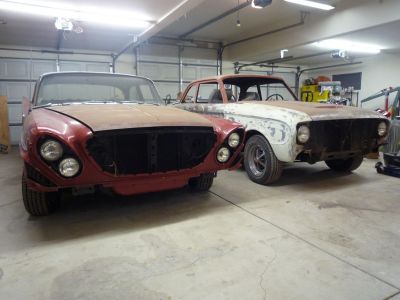
I have a special hatred for CARB because they don't follow the 25 year rule that the EPA does. Who decided that only cars made before 1964 are classics?

People with taste.

normal_Chrysler_10_12_15_1.JPG
 
I have a special hatred for CARB because they don't follow the 25 year rule that the EPA does. Who decided that only cars made before 1964 are classics?

That being said, good riddance to diesel. The cars that run it are noisy, smelly snotboxes here in the US anyway so I'm happy they probably won't be sold here again. I just hope the government makes VW buy back all their shitty cars so the people that bought them don't get screwed too much.

Its 1975 and they aren't exempt because they are classics, but because there was no emissions standards before then and CARB won't require retro-active changes to vehicles.

As long as your vehicle meets the standards from the time of manufacture you are good to go.
 
Honestly, I wouldn't really care about that. Even the "bad" numbers are still better than the alternatives in the same market. I'm kind of surprised that they'd think the "bad" numbers would really hinder sales. :dunno

If VW retrofitted with a DEF system- do you think it would affect performance (other than added weight/cost)?
 
If VW retrofitted with a DEF system- do you think it would affect performance (other than added weight/cost)?

I don't think so. But clearly they don't have to since they're using a fuel-based reducdant method and that method actually does work. I've just never seen it used in small applications like passenger vehicles.
 
:shocker

So wasn't the fix going to be a recall, what were they calling it if not? Are they now forcing a buy back instead? I'm a bit confused.
Also, kudos to the regulators for having balls. Let's hope the US follows suit.
 
Last edited:
:shocker

So wasn't the fix going to be a recall, what were they calling it if not? Are they now forcing a buy back instead? I'm a bit confused.
Also, kudos to the regulators for having balls. Let's hope the US follows suit.

I think it's simply the difference between a voluntary recall and a mandatory recall, but I could be wrong. Doubt it's a buyback, as I don't think the regulators can mandate that. That would have to be decided either by the company unilaterally or through litigation in the courts.
 
Why would the manufacturer be responsible for resale value?

Perhaps because the manufacturer grossly cheated on a major component that renders said final product perhaps illegal to operate?

It's like those folk in Florida finding out the developers knew there was a sinkhole underneath the house. Would you buy that house?
 
Back
Top